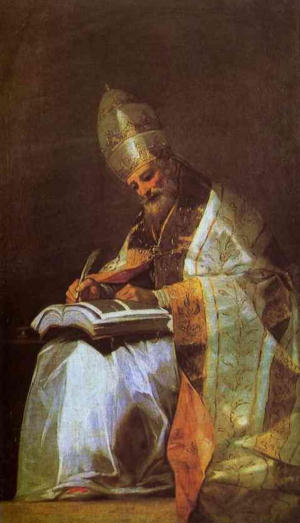
(Thaschus Cæcilius Cyprianus).
Bishop and martyr. Of the date of the saint's birth and of his early life nothing is known. At the time of his conversion to Christianity he had, perhaps, passed middle life. He was famous as an orator and pleader, had considerable wealth, and held, no doubt, a great position in the metropolis of Africa. We learn from his deacon, St. Pontius, whose life of the saint is preserved, that his mien was dignified without severity, and cheerful without effusiveness. His gift of eloquence is evident in his writings. He was not a thinker, a philosopher, a theologian, but eminently a man of the world and an administrator, of vast energies, and of forcible and striking character. His conversion was due to an aged priest named Caecilianus, with whom he seems to have gone to live. Caecilianus in dying commended to Cyprian the care of his wife and family. While yet a catechumen the saint decided to observe chastity, and he gave most of his revenues to the poor. He sold his property, including his gardens at Carthage. These were restored to him (Dei indulgentiâ restituti, says Pontius), being apparently bought back for him by his friends; but he would have sold them again, had the persecution made this imprudent. His baptism probably took place c. 246, presumably on Easter eve, 18 April.
Cyprian's first Christian writing is "Ad Donatum", a monologue spoken to a friend, sitting under a vine-clad pergola. He tells how, until the grace of God illuminated and strengthened the convert, it had seemed impossible to conquer vice; the decay of Roman society is pictured, the gladiatorial shows, the theatre, the unjust law-courts, the hollowness of political success; the only refuge is the temperate, studious, and prayerful life of the Christian. At the beginning should probably be placed the few words of Donatus to Cyprian which are printed by Hartel as a spurious letter. The style of this pamphlet is affected and reminds us of the bombastic unintelligibility of Pontius. It is not like Tertullian, brilliant, barbarous, uncouth, but it reflects the preciosity which Apuleius made fashionable in Africa. In his other works Cyprian addresses a Christian audience; his own fervour is allowed full play, his style becomes simpler, though forcible, and sometimes poetical, not to say flowery. Without being classical, it is correct for its date, and the cadences of the sentences are in strict rhythm in all his more careful writings. On the whole his beauty of style has rarely been equalled among the Latin Fathers, and never surpassed except by the matchless energy and wit of St. Jerome.
Another work of his early days was the "Testimonia ad Quirinum", in two books. It consists of passages of Scripture arranged under headings to illustrate the passing away of the Old Law and its fulfillment in Christ. A third book, added later, contains texts dealing with Christian ethics. This work is of the greatest value for the history of the Old Latin version of the Bible. It gives us an African text closely related to that of the Bobbio manuscript known as k (Turin). Hartel's edition has taken the text from a manuscript which exhibits a revised version, but what Cyprian wrote can be fairly well restored from the manuscript cited in Hartel's notes as L. Another book of excerpts on martyrdom is entitled "Ad Fortunatum"; its text cannot be judged in any printed edition. Cyprian was certainly only a recent convert when he became Bishop of Carthage c. 248 or the beginning of 249, but he passed through all the grades of the ministry. He had declined the charge, but was constrained by the people. A minority opposed his election, including five priests, who remained his enemies; but he tells us that he was validly elected "after the Divine judgment, the vote of the people and the consent of the bishops".
The Decian persecution
_______________________________________________
The prosperity of the Church during a peace of thirty-eight years had produced great disorders. Many even of the bishops were given up to worldliness and gain, and we hear of worse scandals. In October, 249, Decius became emperor with the ambition of restoring the ancient virtue of Rome. In January, 250, he published an edict against Christians. Bishops were to be put to death, other persons to be punished and tortured till they recanted. On 20 January Pope Fabian was martyred, and about the same time St. Cyprian retired to a safe place of hiding. His enemies continually reproached him with this. But to remain at Carthage was to court death, to cause greater danger to others, and to leave the Church without government; for to elect a new bishop would have been as impossible as it was at Rome. He made over much property to a confessor priest, Rogatian, for the needy. Some of the clergy lapsed, others fled; Cyprian suspended their pay, for their ministrations were needed and they were in less danger than the bishop. From his retreat he encouraged the confessors and wrote eloquent panegyrics on the martyrs. Fifteen soon died in prison and one in the mines. On the arrival of the proconsul in April the severity of the persecution increased. St. Mappalicus died gloriously on the 17th. Children were tortured, women dishonoured. Numidicus, who had encouraged many, saw his wife burnt to alive, and was himself half burnt, then stoned and left for dead; his daughter found him yet living; he recovered and Cyprian made him a priest. Some, after being twice tortured, were dismissed or banished, often beggared.
But there was another side to the picture. At Rome terrified Christians rushed to the temples to sacrifice. At Carthage the majority apostatized. Some would not sacrifice, but purchased libelli, or certificates, that they had done so. Some bought the exemption of their family at the price of their own sin. Of these libellatici there were several thousands in Carthage. Of the fallen some did not repent, others joined the heretics, but most of them clamoured for forgiveness and restoration. Some, who had sacrificed under torture, returned to be tortured afresh. Castus and Æmilius were burnt for recanting, others were exiled; but such cases were necessarily rare. A few began to perform canonical penance. The first to suffer at Rome had been a young Carthaginian, Celerinus. He recovered, and Cyprian made him a lector. His grandmother and two uncles had been martyrs, but his two sisters apostatized under fear of torture, and in their repentance gave themselves to the service of those in prison. Their brother was very urgent for their restoration. His letter from Rome to Lucian, a confessor at Carthage, is extant, with the reply of the latter. Lucian obtained from a martyr named Paul before his passion a commission to grant peace to any who asked for it, and he distributed these "indulgences" with a vague formula: "Let such a one with his family communicate". Tertullian speaks in 197 of the "custom" for those who were not at peace with the Church to beg this peace from the martyrs. Much later, in his Montanist days (c. 220) he urges that the adulterers whom Pope Callistus was ready to forgive after due penance, would now get restored by merely imploring the confessors and those in the mines. Correspondingly we find Lucian issuing pardons in the name of confessors who were still alive, a manifest abuse. The heroic Mappalicus had only interceded for his own sister and mother. It seemed now as if no penance was to be enforced upon the lapsed, and Cyprian wrote to remonstrate.
Meanwhile official news had arrived from Rome of the death of Pope Fabian, together with an unsigned and ungrammatical letter to the clergy of Carthage from some of the Roman clergy, implying blame to Cyprian for the desertion of his flock, and giving advice as to the treatment of the lapsed. Cyprian explained his conduct (Ep. xx), and sent to Rome copies of thirteen of the letter he had written from his hiding-place to Carthage. The five priests who opposed him were now admitting at once to communion all who had recommendations from the confessors, and the confessors themselves issued a general indulgence, in accordance with which the bishops were to restore to communion all whom they had examined. This was an outrage on discipline, yet Cyprian was ready to give some value to the indulgences thus improperly granted, but all must be done in submission to the bishop. He proposed that libellatici should be restored, when in danger of death, by a priest or even by a deacon, but that the rest should await the cessation of persecution, when councils could be held at Rome and at Carthage, and a common decision be agreed upon. Some regard must be had for the prerogative of the confessors, yet the lapsed must surely not be placed in a better position than those who had stood fast, and had been tortured, or beggared, or exiled. The guilty were terrified by marvels that occurred. A man was struck dumb on the very Capitol where he had denied Christ. Another went mad in the public baths, and gnawed the tongue which had tasted the pagan victim. In Cyprian's own presence an infant who had been taken by its nurse to partake at the heathen altar, and then to the Holy Sacrifice offered by the bishop, was though in torture, and vomited the Sacred Species it had received in the holy chalice. A lapsed woman of advanced age had fallen in a fit, on venturing to communicate unworthily. Another, on opening the receptacle in which, according to custom, she had taken home the Blessed Sacrament for private Communion, was deterred from sacrilegiously touching it by fire which came forth. Yet another found nought within her pyx save cinders. About September, Cyprian received promise of support from the Roman priests in two letters written by the famous Novatian in the name of his colleagues. In the beginning of 251 the persecution waned, owing to the successive appearance of two rival emperors. The confessors were released, and a council was convened at Carthage. By the perfidy of some priests Cyprian was unable to leave his retreat till after Easter (23 March). But he wrote a letter to his flock denouncing the most infamous of the five priests, Novatus, and his deacon Felicissimus (Ep. xliii). To the bishop's order to delay the reconciliation of the lapsed until the council, Felicissimus had replied by a manifesto, declaring that none should communicate with himself who accepted the large alms distributed by Cyprian's order. The subject of the letter is more fully developed in the treatise "De Ecclesiae Catholicae Unitate" which Cyprian wrote about this time (Benson wrongly thought it was written against Novatian some weeks later).
This celebrated pamphlet was read by its author to the council which met in April, that he might get the support of the bishops against the schism started by Felicissimus and Novatus, who had a large following. The unity with which St. Cyprian deals is not so much the unity of the whole Church, the necessity of which he rather postulates, as the unity to be kept in each diocese by union with the bishop; the unity of the whole Church is maintained by the close union of the bishops who are "glued to one another", hence whosoever is not with his bishop is cut off from the unity of the Church and cannot be united to Christ; the type of the bishop is St. Peter, the first bishop. Protestant controversialists have attributed to St. Cyprian the absurd argument that Christ said to Peter what He really meant for all, in order to give a type or picture of unity. What St. Cyprian really says is simply this, that Christ, using the metaphor of an edifice, founds His Church on a single foundation which shall manifest and ensure its unity. And as Peter is the foundation, binding the whole Church together, so in each diocese is the bishop. With this one argument Cyprian claims to cut at the root of all heresies and schisms. It has been a mistake to find any reference to Rome in this passage (Treatise on Unity 4).
Church unity
_______________________________________________
About the time of the opening of the council (251), two letters arrived from Rome. One of these, announcing the election of a pope, St. Cornelius, was read by Cyprian to the assembly; the other contained such violent and improbable accusations against the new pope that he thought it better to pass it over. But two bishops, Caldonius and Fortunatus, were dispatched to Rome for further information, and the whole council was to await their return-such was the importance of a papal election. Meantime another message arrived with the news that Novatian, the most eminent among the Roman clergy, had been made pope. Happily two African prelates, Pompeius and Stephanus, who had been present at the election of Cornelius, arrived also, and were able to testify that he had been validly set "in the place of Peter", when as yet there was no other claimant. It was thus possible to reply to the recrimination of Novatian's envoys, and a short letter was sent to Rome, explaining the discussion which had taken place in the council. Soon afterwards came the report of Caldonius and Fortunatus together with a letter from Cornelius, in which the latter complained somewhat of the delay in recognizing him. Cyprian wrote to Cornelius explaining his prudent conduct. He added a letter to the confessors who were the main support of the antipope, leaving it to Cornelius whether it should be delivered or no. He sent also copies of his two treatises, "De Unitate" and "De Lapsis" (this had been composed by him immediately after the other), and he wishes the confessors to read these in order that they may understand what a fearful thing is schism. It is in this copy of the "De Unitate" that Cyprian appears most probably to have added in the margin an alternative version of the fourth chapter. The original passage, as found in most manuscripts and as printed in Hartel's edition, runs thus:
"If any will consider this, there is no need of a long treatise and of arguments. 'The Lord saith to Peter: 'I say unto thee that thou art Peter, and upon this rock I will build My Church, and the gates of hell shall not prevail against it; to thee I will give the keys to the kingdom of heaven, and what thou shalt have bound on earth shall be bound in heaven, and what thou shalt have loosed shall be loosed in heaven.' Upon one He builds His Church, and though to all His Apostles after His resurrection He gives an equal power and says: 'As My Father hath sent Me, even so send I you: Receive the Holy Ghost, whosesoever sins you shall have remitted they shall be remitted unto them, and whosesoever sins you shall have retained they shall be retained', yet that He might make unity manifest, He disposed the origin of that unity beginning from one. The other Apostles were indeed what Peter was, endowed with a like fellowship both of honour and of power, but the commencement proceeds from one, that the Church may be shown to be one. This one Church the Holy Ghost in the person of the Lord designates in the Canticle of Canticles, and says, One is My Dove, My perfect one, one is she to her mother, one to her that bare her. He that holds not this unity of the Church, does he believe that he holds the Faith? He who strives against and resists the Church, is he confident that he is in the Church?"
The substituted passage is as follows:
". . . bound in heaven. Upon one He builds His Church, and to the same He says after His resurrection, 'feed My sheep'. And though to all His Apostles He gave an equal power yet did He set up one chair, and disposed the origin and manner of unity by his authority. The other Apostles were indeed what Peter was, but the primacy is given to Peter, and the Church and the chair is shown to be one. And all are pastors, but the flock is shown to be one, which is fed by all the Apostles with one mind and heart. He that holds not this unity of the Church, does he think that he holds the faith? He who deserts the chair of Peter, upon whom the Church is founded, is he confident that he is in the Church?
These alternative versions are given one after the other in the chief family of manuscripts which contains them, while in some other families the two have been partially or wholly combined into one. The combined version is the one which has been printed in man editions, and has played a large part in controversy with Protestants. It is of course spurious in this conflated form, but the alternative form given above is not only found in eighth- and ninth-century manuscripts, but it is quoted by Bede, by Gregory the Great (in a letter written for his predecessor Pelagius II), and by St. Gelasius; indeed, it was almost certainly known to St. Jerome and St. Optatus in the fourth century. The evidence of the manuscripts would indicate an equally early date. Every expression and thought in the passage can be paralleled from St. Cyprian's habitual language, and it seems to be now generally admitted that this alternative passage is an alteration made by the author himself when forwarding his work to the Roman confessors. The "one chair" is always in Cyprian the episcopal chair, and Cyprian has been careful to emphasize this point, and to add a reference to the other great Petrine text, the Charge in John 21. The assertion of the equality of the Apostles as Apostles remains, and the omissions are only for the sake of brevity. The old contention that it is a Roman forgery is at all events quite out of the question. Another passage is also altered in all the same manuscripts which contain the "interpolation"; it is a paragraph in which the humble and pious conduct of the lapsed "on this hand (hic) is contrasted in a long succession of parallels with the pride and wickedness of the schismatics "on that hand" (illic), but in the delicate manner of the treatise the latter are only referred to in a general way. In the "interpolated" manuscripts we find that the lapsed, whose caused had now been settled by the council, are "on that hand" (illic), whereas the reference to the schismatics — meaning the Roman confessors who were supporting Novatian, and to whom the book was being sent — are made as pointed as possible, being brought into the foreground by the repeated hic, "on this hand".
Novatianism
_______________________________________________
The saint's remonstrance had its effect, and the confessors rallied to Cornelius. But for two or three months the confusion throughout the Catholic Church had been terrible. No other event in these early times shows us so clearly the enormous importance of the papacy in East and West. St. Dionysius of Alexandria joined his great influence to that of the Carthaginian primate, and he was very soon able to write that Antioch, Caesarea, and Jerusalem, Tyre and Laodicea, all Cilicia and Cappadocia, Syria and Arabia, Mesopotamia, Pontus, and Bithynia, had returned to union and that their bishops were all in concord (Eusebius, Church History VII. 5). From this we gauge the area of disturbance. Cyprian says that Novatian "assumed the primacy" (Ep. lxix, 8) and sent out his new apostles to very many cities; and where in all provinces and cities there were long established, orthodox bishops, tried in persecution, he dared to create new ones to supplant them, as though he could range through the whole world (Ep. lv, 24). Such was the power assumed by a third-century antipope. Let it be remembered that in the first days of the schism no question of heresy was raised and that Novatian only enunciated his refusal of forgiveness to the lapsed after he had made himself pope. Cyprian's reasons for holding Cornelius to be the true bishop are fully detailed in Ep. lv to a bishop, who had at first yielded to Cyprian's arguments and had commissioned him to inform Cornelius that "he now communicated with him, that is with the Catholic Church", but had afterwards wavered. It is evidently implied that if he did not communicate with Cornelius he would be outside the Catholic Church. Writing to the pope, Cyprian apologizes for his delay in acknowledging him; he had at least urged all those who sailed to Rome to make sure that they acknowledged and held the womb and root of the Catholic Church (Ep. xlviii, 3). By this is probably meant "the womb and root which is the Catholic Church", but Harnack and many Protestants, as well as many Catholics, find here a statement that the Roman Church is the womb and root. Cyprian continues that he had waited for a formal report form the bishops who had been sent to Rome, before committing all the bishops of Africa, Numidia, and Mauretania to a decision, in order that, when no doubt could remain all his colleagues "might firmly approve and hold your communion, that is the unity and charity of the Catholic Church". It is certain that St. Cyprian held that one who was in communion with an antipope held not the root of the Catholic Church, was not nourished at her breast, drank not at her fountain.
So little was the rigorism of Novatian the origin of his schism, that his chief partisan was no other than Novatus, who at Carthage had been reconciling the lapsed indiscriminately without penance. He seems to have arrived at Rome just after the election of Cornelius, and his adhesion to the party of rigorism had the curious result of destroying the opposition to Cyprian at Carthage. It is true that Felicissimus fought manfully for a time; he even procured five bishops, all excommunicated and deposed, who consecrated for the party a certain Fortunatus in opposition to St. Cyprian, in opposition to St. Cyprian, in order not to be outdone by the Novatian party, who had already a rival bishop at Carthage. The faction even appealed to St. Cornelius, and Cyprian had to write to the pope a long account of the circumstances, ridiculing their presumption in "sailing to Rome, the primatial Church (ecclesia principalis), the Chair of Peter, whence the unity of the Episcopate had its origin, not recollecting that these are the Romans whose faith was praised by St. Paul (Romans 1:8), to whom unfaith could have no access". But this embassy was naturally unsuccessful, and the party of Fortunatus and Felicissimus seems to have melted away.
The lapsed
_______________________________________________
With regard to the lapsed the council had decided that each case must be judged on its merits, and that libellatici should be restored after varying, but lengthy, terms of penance, whereas those who had actually sacrificed might after life-long penance receive Communion in the hour of death. But any one who put off sorrow and penance until the hour of sickness must be refused all Communion. The decision was a severe one. A recrudescence of persecution, announced, Cyprian tells us, by numerous visions, caused the assembling of another council in the summer of 252 (so Benson and Nelke, but Ritsch and Harnack prefer 253), in which it was decided to restore at once all those who were doing penance, in order that they might be fortified by the Holy Eucharist against trial. In this persecution of Gallus and Volusianus, the Church of Rome was again tried, but this time Cyprian was able to congratulate the pope on the firmness shown; the whole Church of Rome, he says, had confessed unanimously, and once again its faith, praised by the Apostle, was celebrated throughout the whole world (Ep. lx). About June 253, Cornelius was exiled to Centumcellae (Civitavecchia), and died there, being counted as a martyr by Cyprian and the rest of the Church. His successor Lucius was at once sent to the same place on his election, but soon was allowed to return, and Cyprian wrote to congratulate him. He died 5 March, 254, and was succeeded by Stephen, 12 May, 254.
Rebaptism of heretics
_______________________________________________
Tertullian had characteristically argued long before, that heretics have not the same God, the same Christ with Catholics, therefore their baptism is null. The African Church had adopted this view in a council held under a predecessor of Cyprian, Agrippinus, at Carthage. In the East it was also the custom of Cilicia, Cappadocia, and Galatia to rebaptize Montanists who returned to the church. Cyprian's opinion of baptism by heretics was strongly expresses: "Non abluuntur illic homines, sed potius sordidantur, nec purgantur delicta sed immo cumulantur. Non Deo nativitas illa sed diabolo filios generat" (Treatise on Unity 11). A certain bishop, Magnus, wrote to ask if the baptism of the Novatians was to be respected (Ep. lxix). Cyprian's answer may be of the year 255; he denies that they are to be distinguished from any other heretics. Later we find a letter in the same sense, probably of the spring of 255 (autumn, according to d'Ales), from a council under Cyprian of thirty-one bishops (Ep. lxx), addressed to eighteen Numidian bishops; this was apparently the beginning of the controversy. It appears that the bishops of Mauretania did not in this follow the custom of Proconsular Africa and Numidia, and that Pope Stephen sent them a letter approving their adherence to Roman custom.
Cyprian, being consulted by a Numidian bishop, Quintus, sent him Ep. lxx, and replied to his difficulties (Ep. lxxi). The spring council at Carthage in the following year, 256, was more numerous than usual, and sixty-one bishops signed the conciliar letter to the pope explaining their reasons for rebaptizing, and claiming that it was a question upon which bishops were free to differ. This was not Stephen's view, and he immediately issued a decree, couched apparently in very peremptory terms, that no "innovation" was to be made (this is taken by some moderns to mean "no new baptism"), but the Roman tradition of merely laying hands on converted heretics in sign of absolution must be everywhere observed, on pain of excommunication. This letter was evidently addressed to the African bishops, and contained some severe censures on Cyprian himself. Cyprian writes to Jubainus that he is defending the one Church, the Church founded on Peter-Why then is he called a prevaricator of the truth, a traitor to the truth;? (Ep. lxxiii, 11). To the same correspondent he sends Epp. lxx, lxxi, lxxii; he makes no laws for others, but retains his own liberty. He sends also a copy of his newly written treatise "De Bono Patientiae". To Pompeius, who had asked to see a copy of Stephen's rescript, he writes with great violence: "As you read it, you will note his error more and more clearly: in approving the baptism of all the heresies, he has heaped into his own breast the sins of all of them; a fine tradition indeed! What blindness of mind, what depravity!" — "ineptitude", "hard obstinacy" — such are the expressions which run from the pen of one who declared that opinion on the subject was free, and who in this very letter explains that a bishop must never be quarrelsome, but meek and teachable. In September, 256, a yet larger council assembled at Carthage. All agreed with Cyprian; Stephen was not mentioned; and some writers have even supposed that the council met before Stephen's letter was received (so Ritschl, Grisar, Ernst, Bardenhewer). Cyprian did not wish the responsibility to be all his own. He declared that no one made himself a bishop of bishops, and that all must give their true opinion. The vote of each was therefore given in a short speech, and the minutes have come down to us in the Cyprianic correspondence under the title of "Sententiae Episcoporum". But the messengers sent to Rome with this document were refused an audience and even denied all hospitality by the pope. They returned incontinently to Carthage, and Cyprian tried for support from the East. He wrote to the famous Bishop of Caesarea in Cappadocia, Firmilian, sending him the treatise "De Unitate" and the correspondence on the baptismal question. By the middle of November Firmilian's reply had arrived, and it has come down to us in a translation made at the time in Africa. Its tone is, if possible, more violent than that of Cyprian. (See FIRMILIAN.) After this we know no more of the controversy.
Stephen died on 27 August, 257, and was succeeded by Sixtus II, who certainly communicated with Cyprian, and is called by Pontius "a good and peace-loving bishop". Probably when it was seen at Rome that the East was largely committed to the same wrong practice, the question was tacitly dropped. It should be remembered that, though Stephen had demanded unquestioning obedience, he had apparently, like Cyprian, considered the matter as a point of discipline. St. Cyprian supports his view by a wrong inference from the unity of the Church, and no one thought of the principle afterwards taught by St. Augustine, that, since Christ is always the principal agent, the validity of the sacrament is independent of the unworthiness of the minister: Ipse est qui baptizat. Yet this is what is implied in Stephen's insistence upon nothing more than the correct form, "because baptism is given in the name of Christ", and "the effect is due to the majesty of the Name". The laying on of hands enjoined by Stephen is repeatedly said to be in poenitentiam, yet Cyprian goes on to argue that the gift of the Holy Ghost by the laying on of hands is not the new birth, but must be subsequent to it and implies it. This has led some moderns into the notion that Stephen meant confirmation to be given (so Duchesne), or at least that he has been so misunderstood by Cyprian (d'Alès). But the passage (Ep. lxxiv, 7) need not mean this, and it is most improbable that confirmation was even thought of in this connection. Cyprian seems to consider the laying on of hands in penance to be a giving of the Holy Ghost. In the East the custom of rebaptizing heretics had perhaps arisen from the fact that so many heretics disbelieved in the Holy Trinity, and possibly did not even use the right form and matter. For centuries the practice persisted, at least in the case of some of the heresies. But in the West to rebaptize was regarded as heretical, and Africa came into line soon after St. Cyprian. St. Augustine, St. Jerome, and St. Vincent of Lérins are full of praise for the firmness of Stephen as befitting his place. But Cyprian's unfortunate letters became the chief support of the puritanism of the Donatists. St. Augustine in his "De Baptismo" goes through them one by one. He will not dwell on the violent words quae in Stephanum irritatus effudit, and expresses his confidence that Cyprian's glorious martyrdom will have atoned for his excess.
Appeals to Rome
_______________________________________________
Ep. lxviii was written to Stephen before the breach. Cyprian has heard twice from Faustinus, Bishop of Lyons, that Marcianus, Bishop of Arles, has joined the party of Novatian. The pope will certainly have been already informed of this by Faustinus and by the other bishops of the province. Cyprian urges:
You ought to send very full letters to our fellow-bishops in Gaul, not to allow the obstinate and proud Marcianus any more to insult our fellowship...Therefore send letters to the province and to the people of Arles, by which, Marcianus having been excommunicated, another shall be substituted in his place...for the whole copious body of bishops is joined together by the glue of mutual concord and the bond of unity, in order that if any of our fellowship should attempt to make a heresy and to lacerate and devastate the flock of Christ, the rest may give their aid...For though we are many shepherds, yet we feed one flock.
It seems incontestable that Cyprian is here explaining to the pope why he ventured to interfere, and that he attributes to the pope the power of deposing Marcanus and ordering a fresh election. We should compare his witness that Novatian usurped a similar power as antipope.
Another letter dates perhaps somewhat later. It emanates form a council of thirty seven bishops, and was obviously composed by Cyprian. It is addressed to the priest Felix and the people of Legio and Asturica, and to the deacon Ælius and the people of Emerita, in Spain. It relates that the bishops Felix and Sabinus had come to Carthage to complain. They had been legitimately ordained by the bishops of the province in the place of the former bishops, Basilides and Martialis, who had both accepted libelli in the persecution. Basilides had further blasphemed God, in sickness, had confessed his blasphemy, had voluntarily resigned his bishopric, and had been thankful to be allowed lay communion. Martialis had indulged in pagan banquets and had buried his sons in a pagan cemetery. He had publicly attested before the procurator ducenarius that he had denied Christ. Wherefore, says the letter, such men are unfit to be bishops, the whole Church and the late Pope Cornelius having decided that such men may be admitted to penance but never to ordination; it does not profit them that they have deceived Pope Stephen, who was afar off and unaware of the facts, so that they obtained to be unjustly restored to their sees; nay, by this deceit they have only increased their guilt. The letter is thus a declaration that Stephen was wickedly deceived. No fault is imputed to him, no is there any claim to reverse his decision or to deny his right to give it; it is simply pointed out that it was founded on false information, and was therefore null. But it is obvious that the African council had heard only one side, whereas Felix and Sabinus must have pleaded their cause at Rome before they came to Africa On this ground the Africans seem to have made too hasty a judgment. But nothing more is known of the matter.
Martyrdom
_______________________________________________
The empire was surrounded by barbarian hordes who poured in on all sides. The danger was the signal for a renewal of persecution on the part of the Emperor Valerian. At Alexandria St. Dionysius was exiled. On 30 August, 257, Cyprian was brought before the Proconsul Paternus in his secretarium. His interrogatory is extant and forms the first part of the "Acta proconsularia" of his martyrdom. Cyprian declares himself a Christian and a bishop. He serves one God to Whom he prays day and night for all men and for the safety of the emperor. "Do you persevere in this?" asks Paternus. "A good will which knows God cannot be altered." "Can you, then, go into exile at Curubis?" "I go." He is asked for the names of the priests also, but replies that delation is forbidden by the laws; they will be found easily enough in their respective cities. On September he went to Curubis, accompanied by Pontius. The town was lonely, but Pontius tells us it was sunny and pleasant, and that there were plenty of visitors, while the citizens were full of kindness. He relates at length Cyprian's dream on his first night there, that he was in the proconsul's court and condemned to death, but was reprieved at his own request until the morrow. He awoke in terror, but once awake he awaited that morrow with calmness. It came to him on the very anniversary of the dream. In Numidia the measures were more severe. Cyprian writes to nine bishops who were working in the mines, with half their hair shorn, and with insufficient food and clothing. He was still rich and able to help them. Their replies are preserved, and we have also the authentic Acts of several African martyrs who suffered soon after Cyprian.
In August, 258, Cyprian learned that Pope Sixtus had been put to death in the catacombs on the 6th of that month, together with four of his deacons, in consequence of a new edict that bishops, priests, and deacons should be at once put to death; senators, knights, and others of rank are to lose their goods, and if they still persist, to die; matrons to be exiled; Caesarians (officers of the fiscus) to become slaves. Galerius Maximus, the successor of Paternus, sent for Cyprian back to Carthage, and in his own gardens the bishop awaited the final sentence. Many great personages urged him to fly, but he had now no vision to recommend this course, and he desired above all to remain to exhort others. Yet he hid himself rather than obey the proconsul's summons to Utica, for he declared it was right for a bishop to die in his own city. On the return of Galerius to Carthage, Cyprian was brought from his gardens by two principes in a chariot, but the proconsul was ill, and Cyprian passed the night in the house of the first princeps in the company of his friends. Of the rest we have a vague description by Pontius and a detailed report in the proconsular Acts. On the morning of the 14th a crowd gathered "at the villa of Sextus", by order of the authorities. Cyprian was tried there. He refused to sacrifice, and added that in such a matter there was no room for thought of the consequences to himself. The proconsul read his condemnation and the multitude cried, "Let us be beheaded with him!" He was taken into the grounds, to a hollow surrounded by trees, into which many of the people climbed. Cyprian took off his cloak, and knelt down and prayed. Then he took off his dalmatic and gave it to his deacons, and stood in his linen tunic in silence awaiting the executioner, to whom he ordered twenty-five gold pieces to be given. The brethren cast cloths and handkerchiefs before him to catch his blood. He bandaged his own eyes with the help of a priest and a deacon, both called Julius. So he suffered. For the rest of the day his body was exposed to satisfy the curiosity of the pagans. But at night the brethren bore him with candles and torches, with prayer and great triumph, to the cemetery of Macrobius Candidianus in the suburb of Mapalia. He was the first Bishop of Carthage to obtain the crown of martyrdom.
Writings
_______________________________________________
The correspondence of Cyprian consists of eighty-one letters. Sixty-two of them are his own, three more are in the name of councils. From this large collection we get a vivid picture of his time. The first collection of his writings must have been made just before or just after his death, as it was known to Pontius. It consisted of ten treatises and seven letters on martyrdom. To these were added in Africa a set of letters on the baptismal question, and at Rome, it seems, the correspondence with Cornelius, except Ep. xlvii. Other letters were successively aggregated to these groups, including letters to Cyprian or connected with him, his collections of Testimonies, and many spurious works. To the treatises already mentioned we have to add a well-known exposition of the Lord's Prayer; a work on the simplicity of dress proper to consecrated virgins (these are both founded on Tertullian); "On the Mortality", a beautiful pamphlet, composed on the occasion of the plague which reached Carthage in 252, when Cyprian, with wonderful energy, raised a staff of workers and a great fund of money for the nursing of the sick and the burial of the dead. Another work, "On Almsgiving ", its Christian character, necessity, and satisfactory value, was perhaps written, as Watson has pointed out, in reply to the calumny that Cyprian's own lavish gifts were bribes to attach men to his side. Only one of his writings is couched in a pungent strain, the "ad Demetrianum", in which he replies in a spirited manner to the accusation of a heathen that Christianity had brought the plague upon the world. Two short works, "On Patience" and "On Rivalry and Envy", apparently written during the baptismal controversy, were much read in ancient times. St. Cyprian was the first great Latin writer among the Christians, for Tertullian fell into heresy, and his style was harsh and unintelligible. Until the days of Jerome and Augustine, Cyprian's writings had no rivals in the West. Their praise is sung by Prudentius, who joins with Pacian, Jerome, Augustine, and many others in attesting their extraordinary popularity.
Doctrine
_______________________________________________
The little that can be extracted from St. Cyprian on the Holy Trinity and the Incarnation is correct, judged by later standards. On baptismal regeneration, on the Real Presence, on the Sacrifice of the Mass, his faith is clearly and repeatedly expressed, especially in Ep. lxiv on infant baptism, and in Ep. lxiii on the mixed chalice, written against the sacrilegious custom of using water without wine for Mass. On penance he is clear, like all the ancients, that for those who have been separated from the Church by sin there is no return except by a humble confession (exomologesis apud sacerdotes), followed by remissio facta per sacerdotes. The ordinary minister of this sacrament is the sacerdos par excellence, the bishop; but priests can administer it subject to him, and in case of necessity the lapsed might be restored by a deacon. He does not add, as we should at the present day, that in this case there is no sacrament; such theological distinctions were not in his line. There was not even a beginning of canon law in the Western Church of the third century. In Cyprian's view each bishop is answerable to God alone for his action, though he ought to take counsel of the clergy and of the laity also in all important matters. The Bishop of Carthage had a great position as honorary chief of all the bishops in the provinces of Proconsular Africa, Numidia, and Mauretania, who were about a hundred in number; but he had no actual jurisdiction over them. They seem to have met in some numbers at Carthage every spring, but their conciliar decisions had no real binding force. If a bishop should apostatize or become a heretic or fall into scandalous sin, he might be deposed by his comprovincials or by the pope. Cyprian probably thought that questions of heresy would always be too obvious to need much discussion. It is certain that where internal questions of heresy would always be too obvious to need much discussion. It is certain that where internal discipline was concerned he considered that Rome should not interfere, and that uniformity was not desirable — a most unpractical notion. We have always to remember that his experience as a Christian was of short duration, that he became a bishop soon after he was converted, and that he had no Christian writings besides Holy Scripture to study besides those of Tertullian. He evidently knew no Greek, and probably was not acquainted with the translation of Irenaeus. Rome was to him the centre of the Church's unity; it was inaccessible to heresy, which had been knocking at its door for a century in vain. It was the See of Peter, who was the type of the bishop, the first of the Apostles. Difference of opinion between bishops as to the right occupant of the Sees of Arles or Emerita would not involve breach of communion, but rival bishops at Rome would divide the Church, and to communicate with the wrong one would be schism. It is controverted whether chastity was obligatory or only strongly urged upon priests in his day. The consecrated virgins were to him the flower of his flock, the jewels of the Church, amid the profligacy of paganism.
Spuria
_______________________________________________
A short treatise, "Quod Idola dii non sint", is printed in all editions as Cyprian's. It is made up out of Tertullian and Minucius Felix. Its genuineness is accepted by Benson, Monceaux, and Bardenhewer, as it was anciently by Jerome and Augustine. It has been attributed by Haussleiter to Novatian, and is rejected by Harnack, Watson, and von Soden. "De Spectaculis" and "De bono pudicitiae" are, with some probability, ascribed to Novatian. They are well-written letters of an absent bishop to his flock. "De Laude martyrii" is again attributed by Harnack to Novatian; but this is not generally accepted. "Adversus Judaeos" is perhaps by a Novatianist and Harnack ascribes it to Novatian himself. "Ad Novatianum" is ascribed by Harnack to Pope Sixtus II. Ehrhard, Benson, Nelke, and Weyman agree with him that it was written in Rome. This is denied by Julicher, Bardenhewer, Monceaux. Rombold thinks it is by Cyprian. "De Rebaptismate" is apparently the work attributed by Genadius to a Roman named Ursinus, c. 400. He was followed by some earlier critics, Routh, Oudin, and lately by Zahn. But it was almost certainly written during the baptismal controversy under Stephen. It comes from Rome (so Harnack and others) or from Mauretania (so Ernst, Monceaux, d'Arles), and is directed against the view of Cyprian. The little homily "De Aleatoribus" has had quite a literature of its own within the last few years, since it was attributed by Harnack to Pope Victor, and therefore accounted the earliest Latin ecclesiastical writing. The controversy has at least made it clear that the author was either very early or not orthodox. It has been shown to be improbable that he was very early, and Harnack now admits that the work is by an antipope, either Novatianist or Donatist. References to all the brochures and articles on the subject will be found in Ehrhard, in Bardenhewer, and especially in Harnack (Chronol., II, 370 sqq.).
"De Montibus Sina et Sion" is possibly older than Cyprian's time (see Harnack, and also Turner in Journal of Theol. Studies, July 1906). "Ad Vigilium Episcopum de Judaica incredulitate" is by a certain Celsus, and was once supposed by Harnack and Zahn to be addressed to the well-known Vigilius of Thapsus, but Macholz has now convinced Harnack that it dates from either the persecution of Valerian or that of Maxentius. The two "Orationes" are of uncertain date and authorship. The tract "De Singularitate clericorum" has been attributed by Dom Morin and by Harnack to the Donatist Bishop Macrobius in the fourth century. "De Duplici Martyrio ad Fortunatum" is found in no manuscript, and was apparently written by Erasmus in 1530. "De Paschâ computus" was written in the year preceding Easter, 243. All the above spuria are printed in Hartel's edition of Cyprian. The "Exhortatio de paenitentia" (first printed by Trombelli in 1751) is placed in the fourth or fifth century by Wunderer, but in Cyprian's time or Monceaux. Four letter are also given by Hartel; the first is the original commencement of the "Ad Donatum". The others are forgeries; the third, according to Mercati, is by a fourth-century Donatist. The six poems are by one author, of quite uncertain date. The amusing "Cena Cypriani" is found in a large number of Cyprianic manuscripts. Its date is uncertain; it was re-edited by Blessed Rhabanus Maurus. On the use of it at pageants in the early Middle Ages, see Mann, "History of the Popes", II, 289.
The principal editions of the works of St. Cyprian are: Rome, 1471 (the ed. princeps), dedicated to Paul II; reprinted, Venice, 1471, and 1483; Memmingen, c. 1477; Deventer, c. 1477; Paris, 1500; ed. by Rembolt (Paris, 1512); by Erasmus (Basle, 1520 and frequently; the ed. of 1544 was printed at Cologne). A careful critical edition was prepared by Latino Latini, and published by Manutius (Rome, 1563); Morel also went to the manuscripts (Paris, 1564); so did Pamele (Antwerp, 1568), but with less success; Rigault did somewhat better (Paris, 1648, etc.). John Fell, Bishop of Oxford and Dean of Christ Church, published a well-known edition from manuscripts in England (Oxford, 1682). The dissertations by Dodwell and the "Annales Cyprianici" by Pearson, who arranged the letters in chronological order, make this edition important, though the text is poor. The edition prepared by Etienne Baluze was brought out after his death by Dom Prudence Maran (Paris, 1726), and has been several times reprinted, especially by Migne (P.L., IV and V). The best edition is that of the Vienna Academy (C.S.E.L., vol. III, in 3 parts, Vienna, 1868-1871), edited from the manuscripts by Hartel. Since then much work has been done upon the history of the text, and especially on the order of the letters and treatises as witnessing to the genealogy of the codices.
Sources
_______________________________________________
A stichometrical list, probably made in 354, of the Books of the Bible, and of many works of St. Cyprian, was published in 1886 from a manuscript then at Cheltenham by MOMMSEN, Zur lat. Stichometric; Hermes, XXI, 142; ibid. (1890), XXV, 636, on a second MS. at St. Gall. See SANDAY and TURNER in Studia Biblica (Oxford, 1891), III; TURNER in Classical Review (1892), etc.), VI, 205. On Oxford MSS., see WORDSWORTh in Old Lat. Biblical Texts (Oxford, 1886), II, 123; on Madrid MSS., SCHULZ, Th. Lit. Zeitung (1897), p. 179. On other MSS., TURNER in Journal of Th. St., III, 282, 586, 579; RAMSAY, ibid., III, 585, IV, 86. On the significance of the order, CHAPMAN, ibid., IV, 103; VON SODEN, Die cyprianische Briefsammlung (Leipzig, 1904). There are many interesting points in MERCATI, D'alcuni nuovi sussidi per la critica del testo di S. Cipriano (Rome, 1899).
On the life of St. Cyprian: PEARSON, Annales Cyprianici, ed. FELL; Acta SS., 14 Sept; RETTBERG, Th. Caec. Cyprianus (Gottingen, 1831); FREPPEL, Saint Cyprien et l'Église d'Afrique (Paris, 1865, etc.); PETERS, Der hl. Cypr. v. Karth. Ratisbon, 1877); Freppel and Peters occasionally exaggerate in the Catholic interest. FECHTRUP, Der hl. Cyprian (Munster, 1878); RITSCHL, Cyprian v. K. und die Verfassung der Kirche (Gottingen, 1885); BENSON, Cyprian, his life, his times, his work (London, 1897). (This is the fullest and best English life; it is full of enthusiasm, but marred by odium theologicum, and quite untrustworthy when controversial point arise, whether against Nonconformists or against Catholics.) MONCEAUX, Hist. litt. de l'Afrique chret. (Paris, 1902), II, a valuable work. Of the accounts in histories, encyclopedias, and patrologies, the best is that of BARDENHEWER, Gesch. der altkirchl. Lit. (Freiburg, 1903), II. PEARSON's chronological order of the letters is given in HARTEL's edition. Rectifications are proposed by RITSCHL, De Epistulis Cyprianicis (Halle, 1885), and Cyprian v. Karthago (Gottingen, 1885); by NELKE, Die Chronologie der Korresp. Cypr. (Thorn, 1902); by VON SODEN, op. cit.; by BENSON and MONCEAUX. These views are discussed by BARDENHEWER. loc. cit., and HARNACK, Chronol., II. BONACCORSI, Le lettere di S. Cipriano in Riv. storico-critica delle scienze teol. (Rome, 1905), I, 377; STUFLER, Die Behandlung der Gefallenen zur Zeit der decischen Verfolgung in Zeitschrift fur Kathol. Theol., 1907, XXXI, 577; DWIGHT, St. Cyprian and the libelli martyrum in Amer. Cath. Qu. Rev. (1907), XXXII, 478. On the chronology of the baptismal controversy, D'ALES, La question baptismale au temps de Saint-Cyprien in Rev. des Questions Hist. (1907), p. 353.
On Cyprian's Biblical text: CORSSEN, Zur Orientierung uber die bisherige Erforschung der klass. Altertumswiss. (1899); SANDAY in Old Latin Bibl. Texts (1886), II; TURNER in Journ. Theol. St., II, 600, 610; HEIDENREICH, Der ntl. Text bei Cyprian (Bamberg, 1900); MONCEAUX, op. cit.; CORSSEN, Der cypr. Text der Acta Ap. (Berlin, 1892); ZAHN, Forschungen (Erlangen, 1891), IV, 79 (on Cyprian's text of the Apoc.). A new edition (Oxford Univ. Press) is expected of the Testimonia by SANDAY and TURNER. Tentative prolegomena to it by TURNER in Journal Theological Studies (1905), VI, 246, and (1907), IX, 62. The work has been interpolated; see RAMSAY, On early insertions in the third book of St. Cyprian's Text in Journal of Theol. St. (1901), II, 276. Testimonies of the ancients to Cyprian in HARNACK, Gesch. der altchristl. Lit., I; GOTZ, Gesch. der cyprianischen Literatur bis zu der Zeit der ersten erhaltenen Handschriften (Basle, 1891). On the Latin of St. Cyprian an excellent essay by WATSON, The Style and Language of St. Cyprian in Stud. Bibl. (Oxford, 1896), IV; BAYARD, Le Latin de Saint Cyprien (Paris, 1902). The letters of Cornelius are in Vulgar Latin (see MERCATI, op. cit.), and so are Epp. viii (anonymous) and xxi-xxiv (Celerinus, Lucian, Confessors, Caldonius); they have been edited by MIODONSKI, Adversus Alcatores (Erlangen and Leipzig, 1889). On the interpolations in De Unitate Eccl., see HARTEL, Preface; BENSON, pp. 200-21, 547-552; CHAPMAN, Les interpolations dans le traite de Saint Cyprien sur l'unite de l'Église in Revue Benedictine (1902), XIX, 246, 357, and (1903), XX, 26; HARNACK in Theo. Litt. Zeitung (1903), no. 9, and in Chronol., II; WATSON in Journal Theol. St. (1904), p. 432; CHAPMAN, ibid., p. 634, etc. On particular points see HARNACK in Texte und Untersuch., IV, 3, VIII, 2; on the letters of the Roman clergy HARNACK in Theol. Abhandl. Carl v. Weisacker gewidmet (Freiburg, 1896).
On Cyprian's theology much has been written. RITSCHL is fanciful and unsympathetic, BENSON untrustworthy. GOTZ, Das Christentum Cyprians (Giessen, 1896). On his trust in visions, HARNACK, Cyprian als Enthusiast in Zeitschr. fur ntl. Wiss. (1902), III, ibid. On the baptismal controversy and Cyprian's excommunication, see GRISAR in Zeitschr. fur kath. Theol. (1881), V; HOENSBROECH, ibid. (1891), XV; ERNST, ibid., XVII, XVIII, XIX. POSCHMANN, Die Sichtbarkeit der Kirche nach der Lehre des h. Cypr. (Breslau, 1907); RIOU, La genese de l'unite catholique et la pensee de Cyprien (Paris, 1907). To merely controversial works it is unnecessary to refer.
The above is only a selection from an immense literature on Cyprian and the pseudo-Cyprianic writings, for which see CHEVALIER, Bio-Bibl., and RICHARDSON, Bibliographical Synopsis. Good lists in VON SODEN, and in HARNACK, Chronol., II; the very full references in BARDENHEWER are conveniently classified.
_______________________________________________
Chapman, J. (1908). St. Cyprian of Carthage. In The Catholic Encyclopedia. New York: Robert Appleton Company.
Wednesday, March 2, 2016
Tuesday, March 1, 2016
St. Leo the Great: Sermon 46, On Lent (VIII)
I. Lent must be kept not only by avoiding bodily impurity but also by avoiding errors of thought and faith
___________________________________________
WE know indeed, dearly-beloved, your devotion to be so warm that in the fasting, which is the forerunner of the Lord's Easter, many of you will have forestalled our exhortations. But because the right practice of abstinence is needful not only to the mortification of the flesh but also to the purification of the mind, we desire your observance to be so complete that, as you cut down the pleasures that belong to the lusts of the flesh, so you should banish the errors that proceed from the imaginations of the heart. For he whose heart is polluted with no misbelief prepares himself with true and reasonable purification for the Paschal Feast, in which all the mysteries of our religion meet together. For, as the Apostle says, that “all that is not of faith is sin (Rm 14:23),” the fasting of those will be unprofitable and vain, whom the father of lying deceives with his delusions, and who are not fed by Christ's true flesh. As then we must with the whole heart obey the Divine commands and sound doctrine, so we must use all foresight in abstaining from wicked imaginations. For the mind then only keeps holy and spiritual fast when it rejects the food of error and the poison of falsehood, which our crafty and wily foe plies us with more treacherously now, when by the very return of the venerable Festival, the whole church generally is admonished to understand the mysteries of its salvation. For he is the true confessor and worshipper of Christ's resurrection, who is not confused about His passion, nor deceived about His bodily nativity. For some are so ashamed of the Gospel of the Cross of Christ, as to impudently nullify the punishment which He underwent for the world's redemption, and have denied the very nature of true flesh in the Lord, not understanding how the impassible and unchangeable Deity of God's Word could have so far condescended for man's salvation, as by His power not to lose His own properties, and in His mercy to take on Him ours. And so in Christ, there is a twofold form but one person, and the Son of God, who is at the same time Son of Man, is one Lord, accepting the condition of a slave by the design of loving-kindness, not by the law of necessity, because by His power He became humble, by His power passible, by His power mortal; that for the destruction of the tyranny of sin and death, the weak nature in Him might be capable of punishment, and the strong nature not lose anything of its glory.
II. All the actions of Christ reveal the presence of the twofold nature
___________________________________________
And so, dearly-beloved, when in reading or hearing the Gospel you find certain things in our Lord Jesus Christ subjected to injuries and certain things illumined by miracles, in such a way that in the same Person now the Humanity appears, and now the Divinity shines out, do not put down any of these things to a delusion, as if in Christ there is either Manhood alone or Godhead alone, but believe both faithfully, worship both right humbly; so that in the union of the Word and the Flesh there may be no separation, and the bodily proofs may not seem delusive, because the divine signs were evident in Jesus. The attestations to both natures in Him are true and abundant, and by the depth of the Divine purpose all concur to this end, that the inviolable Word not being separated from the passible flesh, the Godhead may be understood as in all things partaker with the flesh and flesh with the Godhead. And, therefore, must the Christian mind that would eschew lies and be the disciple of truth, use the Gospel-story confidently, and, as if still in company with the Apostles themselves, distinguish what is visibly done by the Lord, now by the spiritual understanding and now by the bodily organs of sight. Assign to the man that He is born a boy of a woman: assign to God that His mother's virginity is not harmed, either by conception or by bearing. Recognize “the form of a slave” enwrapped in swaddling clothes, lying in a manger, but acknowledge that it was the Lord's form that was announced by angels, “proclaimed by the elements,” adored by the wise men. Understand it of His humanity that he did not avoid the marriage feast: confess it Divine that he turned water into wine. Let your own feelings explain to you why He shed tears over a dead friend: let His Divine power be realized, when that same friend, after mouldering in the grave four days, is brought to life and raised only by the command of His voice. To make clay with spittle and earth was a work of the body: but to anoint therewith and enlighten the eyes of the blind is an undoubted mark of that power which had reserved for the revelation of its glory that which it had not allowed to the early part of His natural life. It is truly human to relieve bodily fatigue with rest in sleep: but it is truly Divine to quell the violence of raging storms by a rebuking command. To set food before the hungry denotes human kindness and a philanthropic spirit: but with five loaves and two fishes to satisfy 5,000 men, besides women and children, who would dare deny that to be the work of Deity? A Deity which, by the co-operation of the functions of true flesh, showed not only itself in Manhood, but also Manhood in itself; for the old, original wounds in man's nature could not be healed, except by the Word of God taking to Himself flesh from the Virgin's womb, whereby in one and the same Person flesh and the Word co-existed.
III. Hold fast to the statements of the Creed
___________________________________________
This belief in the Lord's Incarnation, dearly-beloved, through which the whole Church is Christ's body, hold firm with heart unshaken and abstain from all the lies of heretics, and remember that your works of mercy will only then profit you, and your strict continence only then bear fruit, when your minds are unsoiled by any defilement from wrong opinions. Cast away the arguments of this world's wisdom, for God hates them, and none can arrive by them at the knowledge of the Truth, and keep fixed in your mind that which you say in the Creed. Believe the Son of God to be co-eternal with the Father by Whom all things were made and without Whom nothing was made, born also according to the flesh at the end of the times. Believe Him to have been in the body crucified, dead, raised up, and lifted above the heights of heavenly powers, set on the Father's right hand, about to come in the same flesh in which He ascended, to judge the living and the dead. For this is what the Apostle proclaims to all the faithful, saying: “if you be risen with Christ seek the things which are above, where Christ is sitting on the right hand of God. Set your mind on the things that are above, not on the things that are upon the earth. For you are dead, and your life is hid with Christ in God. For when Christ, our life, shall appear, then shall you also appear with Him in glory (Col 3:1-4).”
IV. Use Lent for general improvement in the whole round of Christian duties
___________________________________________
Relying, therefore, dearly-beloved, on so great a promise, be heavenly not only in hope, but also in conduct. And though our minds must at all times be set on holiness of mind and body, yet now during these 40 days of fasting bestir yourselves to yet more active works of piety, not only in the distribution of alms, which are very effectual in attesting reform, but also in forgiving offenses, and in being merciful to those accused of wrongdoing, that the condition which God has laid down between Himself and us may not be against us when we pray. For when we say, in accordance with the Lord's teaching, “Forgive us our debts, as we also forgive our debtors (Mt 6:12),” we ought with the whole heart to carry out what we say. For then only will what we ask in the next clause come to pass, that we be not led into temptation and freed from all evils: through our Lord Jesus Christ, Who with the Father and the Holy Spirit lives and reigns for ever and ever. Amen.
___________________________________________
Source. Nicene and Post-Nicene Fathers, Second Series, Vol. 12. Edited by Philip Schaff and Henry Wace. Buffalo, NY: Christian Literature Publishing Co., 1895.
See also: Catholic Encyclopedia: Pope St. Leo I (the Great)
___________________________________________
WE know indeed, dearly-beloved, your devotion to be so warm that in the fasting, which is the forerunner of the Lord's Easter, many of you will have forestalled our exhortations. But because the right practice of abstinence is needful not only to the mortification of the flesh but also to the purification of the mind, we desire your observance to be so complete that, as you cut down the pleasures that belong to the lusts of the flesh, so you should banish the errors that proceed from the imaginations of the heart. For he whose heart is polluted with no misbelief prepares himself with true and reasonable purification for the Paschal Feast, in which all the mysteries of our religion meet together. For, as the Apostle says, that “all that is not of faith is sin (Rm 14:23),” the fasting of those will be unprofitable and vain, whom the father of lying deceives with his delusions, and who are not fed by Christ's true flesh. As then we must with the whole heart obey the Divine commands and sound doctrine, so we must use all foresight in abstaining from wicked imaginations. For the mind then only keeps holy and spiritual fast when it rejects the food of error and the poison of falsehood, which our crafty and wily foe plies us with more treacherously now, when by the very return of the venerable Festival, the whole church generally is admonished to understand the mysteries of its salvation. For he is the true confessor and worshipper of Christ's resurrection, who is not confused about His passion, nor deceived about His bodily nativity. For some are so ashamed of the Gospel of the Cross of Christ, as to impudently nullify the punishment which He underwent for the world's redemption, and have denied the very nature of true flesh in the Lord, not understanding how the impassible and unchangeable Deity of God's Word could have so far condescended for man's salvation, as by His power not to lose His own properties, and in His mercy to take on Him ours. And so in Christ, there is a twofold form but one person, and the Son of God, who is at the same time Son of Man, is one Lord, accepting the condition of a slave by the design of loving-kindness, not by the law of necessity, because by His power He became humble, by His power passible, by His power mortal; that for the destruction of the tyranny of sin and death, the weak nature in Him might be capable of punishment, and the strong nature not lose anything of its glory.
II. All the actions of Christ reveal the presence of the twofold nature
___________________________________________
And so, dearly-beloved, when in reading or hearing the Gospel you find certain things in our Lord Jesus Christ subjected to injuries and certain things illumined by miracles, in such a way that in the same Person now the Humanity appears, and now the Divinity shines out, do not put down any of these things to a delusion, as if in Christ there is either Manhood alone or Godhead alone, but believe both faithfully, worship both right humbly; so that in the union of the Word and the Flesh there may be no separation, and the bodily proofs may not seem delusive, because the divine signs were evident in Jesus. The attestations to both natures in Him are true and abundant, and by the depth of the Divine purpose all concur to this end, that the inviolable Word not being separated from the passible flesh, the Godhead may be understood as in all things partaker with the flesh and flesh with the Godhead. And, therefore, must the Christian mind that would eschew lies and be the disciple of truth, use the Gospel-story confidently, and, as if still in company with the Apostles themselves, distinguish what is visibly done by the Lord, now by the spiritual understanding and now by the bodily organs of sight. Assign to the man that He is born a boy of a woman: assign to God that His mother's virginity is not harmed, either by conception or by bearing. Recognize “the form of a slave” enwrapped in swaddling clothes, lying in a manger, but acknowledge that it was the Lord's form that was announced by angels, “proclaimed by the elements,” adored by the wise men. Understand it of His humanity that he did not avoid the marriage feast: confess it Divine that he turned water into wine. Let your own feelings explain to you why He shed tears over a dead friend: let His Divine power be realized, when that same friend, after mouldering in the grave four days, is brought to life and raised only by the command of His voice. To make clay with spittle and earth was a work of the body: but to anoint therewith and enlighten the eyes of the blind is an undoubted mark of that power which had reserved for the revelation of its glory that which it had not allowed to the early part of His natural life. It is truly human to relieve bodily fatigue with rest in sleep: but it is truly Divine to quell the violence of raging storms by a rebuking command. To set food before the hungry denotes human kindness and a philanthropic spirit: but with five loaves and two fishes to satisfy 5,000 men, besides women and children, who would dare deny that to be the work of Deity? A Deity which, by the co-operation of the functions of true flesh, showed not only itself in Manhood, but also Manhood in itself; for the old, original wounds in man's nature could not be healed, except by the Word of God taking to Himself flesh from the Virgin's womb, whereby in one and the same Person flesh and the Word co-existed.
III. Hold fast to the statements of the Creed
___________________________________________
This belief in the Lord's Incarnation, dearly-beloved, through which the whole Church is Christ's body, hold firm with heart unshaken and abstain from all the lies of heretics, and remember that your works of mercy will only then profit you, and your strict continence only then bear fruit, when your minds are unsoiled by any defilement from wrong opinions. Cast away the arguments of this world's wisdom, for God hates them, and none can arrive by them at the knowledge of the Truth, and keep fixed in your mind that which you say in the Creed. Believe the Son of God to be co-eternal with the Father by Whom all things were made and without Whom nothing was made, born also according to the flesh at the end of the times. Believe Him to have been in the body crucified, dead, raised up, and lifted above the heights of heavenly powers, set on the Father's right hand, about to come in the same flesh in which He ascended, to judge the living and the dead. For this is what the Apostle proclaims to all the faithful, saying: “if you be risen with Christ seek the things which are above, where Christ is sitting on the right hand of God. Set your mind on the things that are above, not on the things that are upon the earth. For you are dead, and your life is hid with Christ in God. For when Christ, our life, shall appear, then shall you also appear with Him in glory (Col 3:1-4).”
IV. Use Lent for general improvement in the whole round of Christian duties
___________________________________________
Relying, therefore, dearly-beloved, on so great a promise, be heavenly not only in hope, but also in conduct. And though our minds must at all times be set on holiness of mind and body, yet now during these 40 days of fasting bestir yourselves to yet more active works of piety, not only in the distribution of alms, which are very effectual in attesting reform, but also in forgiving offenses, and in being merciful to those accused of wrongdoing, that the condition which God has laid down between Himself and us may not be against us when we pray. For when we say, in accordance with the Lord's teaching, “Forgive us our debts, as we also forgive our debtors (Mt 6:12),” we ought with the whole heart to carry out what we say. For then only will what we ask in the next clause come to pass, that we be not led into temptation and freed from all evils: through our Lord Jesus Christ, Who with the Father and the Holy Spirit lives and reigns for ever and ever. Amen.
___________________________________________
Source. Nicene and Post-Nicene Fathers, Second Series, Vol. 12. Edited by Philip Schaff and Henry Wace. Buffalo, NY: Christian Literature Publishing Co., 1895.
See also: Catholic Encyclopedia: Pope St. Leo I (the Great)
Labels:
Lent,
Leo the Great,
Pope St Leo I
Friday, February 26, 2016
Benedict XV: Spiritus Paraclitus (On St. Jerome)
![]() |
| Pope Benedict XV |
To all the Patriarchs, Primates, Archbishops, Bishops, and Ordinaries in Union with the Apostolic See.
Since the Holy Spirit, the Comforter, had bestowed the Scriptures on the human race for their instruction in Divine things, He also raised up in successive ages saintly and learned men whose task it should be to develop that treasure and so provide for the faithful plenteous "consolation from the Scriptures."[1] Foremost among these teachers stands St. Jerome. Him the Catholic Church acclaims and reveres as her "Greatest Doctor," divinely given her for the understanding of the Bible. And now that the fifteenth centenary of his death is approaching we would not willingly let pass so favorable an opportunity of addressing you on the debt we owe him. For the responsibility of our Apostolic office impels us to set before you his wonderful example and so promote the study of Holy Scripture in accordance with the teaching of our predecessors, Leo XIII and Pius X, which we desire to apply more precisely still to the present needs of the Church. For St. Jerome ─ "strenuous Catholic, learned in the Scriptures,"[2] "teacher of Catholics,"[3] "model of virtue, world's teacher"[4] ─ has by his earnest and illuminative defense of Catholic doctrine on Holy Scripture left us most precious instructions. These we propose to set before you and so promote among the children of the Church, and especially among the clergy, assiduous and reverent study of the Bible.
2. No need to remind you, Venerable Brethren, that Jerome was born in Stridonia, in a town "on the borders of Dalmatia and Pannonia";[5] that from his infancy he was brought up a Catholic;[6] that after his baptism here in Rome[7] he lived to an advanced age and devoted all his powers to studying, expounding, and defending the Bible. At Rome he had learned Latin and Greek, and hardly had he left the school of rhetoric than he ventured on a Commentary on Abdias the Prophet. This "youthful piece of work"[8] kindled in him such love of the Bible that he decided ─ like the man in the Gospel who found a treasure ─ to spurn "any emoluments the world could provide,"[9] and devote himself wholly to such studies. Nothing could deter him from this stern resolve. He left home, parents, sister, and relatives; he denied himself the more delicate food he had been accustomed to, and went to the East so that he might gather from studious reading of the Bible the fuller riches of Christ and true knowledge of his Savior.[10] Jerome himself tells us in several places how assiduously he toiled:
An eager desire to learn obsessed me. But I was not so foolish as to try and teach myself. At Antioch I regularly attended the lectures of Apollinaris of Laodicea; but while I learned much from him about the Bible, I would never accept his doubtful teaching about its interpretation.[11]
3. From Antioch be betook to the desert of Chalcis, in Syria, to perfect himself in his knowledge of the Bible, and at the same time to curb "youthful desires" by means of hard study. Here he engaged a convert Jew to teach him Hebrew and Chaldaic.
What a toil it was! How difficult I found it! How often I was on the point of giving it up in despair, and yet in my eagerness to learn took it up again! Myself can bear witness of this, and so, too, can those who had lived with me at the time. Yet I thank God for the fruit I won from that bitter seed.[12]
4. Lest, however, he should grow idle in this desert where there were no heretics to vex him, Jerome betook himself to Constantinople, where for nearly three years he studied Holy Scripture under St. Gregory the Theologian, then Bishop of that See and in the height of his fame as a teacher. While there he translated into Latin Origen's Homilies on the Prophets and Eusebius' Chronicle; he also wrote on Isaias' vision of the Seraphim. He then returned to Rome on ecclesiastical business, and Pope Damasus admitted him into his court.[13] However, he let nothing distract him from continual occupation with the Bible,[14] and the task of copying various manuscripts,[15] as well as answering the many questions put to him by students of both sexes.[16]
5. Pope Damasus had entrusted to him a most laborious task, the correction of the Latin text of the Bible. So well did Jerome carry this out that even today men versed in such studies appreciate its value more and more. But he ever yearned for Palestine, and when the Pope died he retired to Bethlehem to a monastery nigh to the cave where Christ was born. Every moment he could spare from prayer he gave to Biblical studies.
Though my hair was now growing gray and though I looked more like professor than student, yet I went to Alexandria to attend Didymus' lectures. I owe him much. What I did not know I learned. What I knew already I did not lose through his different presentation of it. Men thought I had done with tutors; but when I got back to Jerusalem and Bethlehem how hard I worked and what a price I paid for my night-time teacher Baraninus! Like another Nicodemus he was afraid of the Jews![17]
6. Nor was Jerome content merely to gather up this or that teacher's words; he gathered from all quarters whatever might prove of use to him in this task. From the outset he had accumulated the best possible copies of the Bible and the best commentators on it, but now he worked on copies from the synagogues and from the library formed at Caesarea by Origen and Eusebius; he hoped by assiduous comparison of texts to arrive at greater certainty touching the actual text and its meaning. With this same purpose he went all through Palestine. For he was thoroughly convinced of the truth of what he once wrote to Domnio and Rogatian:
A man will understand the Bible better if he has seen Judaea with his own eyes and discovered its ancient cities and sites either under the old names or newer ones. In company with some learned Hebrews I went through the entire land the names of whose sites are on every Christian's lips.[18]
7. He nourished his soul unceasingly on this most pleasant food: he explained St. Paul's Epistles; he corrected the Latin version of the Old Testament by the Greek; he translated afresh nearly all the books of the Old Testament from Hebrew into Latin; day by day he discussed Biblical questions with the brethren who came to him, and answered letters on Biblical questions which poured in upon him from all sides; besides all this, he was constantly refuting men who assailed Catholic doctrine and unity. Indeed, such was his love for Holy Scripture that he ceased not from writing or dictating till his hand stiffened in death and his voice was silent forever. So it was that, sparing himself neither labor nor watching nor expense, he continued to extreme old age meditating day and night beside the Crib on the Law of the Lord; of greater profit to the Catholic cause by his life and example in his solitude than if he had passed his life at Rome, the capital of the world.
8. After this preliminary account of St. Jerome's life and labors we may now treat of his teaching on the divine dignity and absolute truth of Scripture.
You will not find a page in his writings which does not show clearly that he, in common with the whole Catholic Church, firmly and consistently held that the Sacred Books ─ written as they were under the inspiration of the Holy Spirit ─ have God for their Author, and as such were delivered to the Church. Thus he asserts that the Books of the Bible were composed at the inspiration, or suggestion, or even at the dictation of the Holy Spirit; even that they were written and edited by Him. Yet he never questions but that the individual authors of these Books worked in full freedom under the Divine afflatus, each of them in accordance with his individual nature and character. Thus he is not merely content to affirm as a general principle ─ what indeed pertains to all the sacred writers ─ that they followed the Spirit of God as they wrote, in such sort that God is the principal cause of all that Scripture means and says; but he also accurately describes what pertains to each individual writer. In each case Jerome shows us how, in composition, in language, in style and mode of expression, each of them uses his own gifts and powers; hence he is able to portray and describe for us their individual character, almost their very features; this is especially so in his treatment of the Prophets and of St. Paul. This partnership of God and man in the production of a work in common Jerome illustrates by the case of a workman who uses instruments for the production of his work; for he says that whatsoever the sacred authors say "Is the word of God, and not their own; and what the Lord says by their mouths He says, as it were, by means of an instrument."[19]
9. If we ask how we are to explain this power and action of God, the principal cause, on the sacred writers we shall find that St. Jerome in no wise differs from the common teaching of the Catholic Church. For he holds that God, through His grace, illumines the writer's mind regarding the particular truth which, "in the person of God," he is to set before men; he holds, moreover, that God moves the writer's will ─ nay, even impels it ─ to write; finally, that God abides with him unceasingly, in unique fashion, until his task is accomplished. Whence the Saint infers the supreme excellence and dignity of Scripture, and declares that knowledge of it is to be likened to the "treasure"[20] and the "pearl beyond price,"[21] since in them are to be found the riches of Christ[22] and "silver wherewith to adorn God's house."[23]
10. Jerome also insists on the supereminent authority of Scripture. When controversy arose he had recourse to the Bible as a storehouse of arguments, and he used its testimony as a weapon for refuting his adversaries' arguments, because he held that the Bible's witness afforded solid and irrefutable arguments. Thus, when Helvidius denied the perpetual virginity of the Mother of God, Jerome was content simply to reply:
Just as we do not deny these things which are written, so do we repudiate things that are not written. That God was born of a Virgin we believe, because we read it. That Mary was married after His birth we do not believe because we do not read it.[24]
11. In the same fashion he undertakes to defend against Jovinian, with precisely the same weapons, the Catholic doctrines of the virginal state, of perseverance, of abstinence, and of the merit of good works:
In refuting his statements I shall rely especially on the testimony of Scripture, lest he should grumble and complain that he has been vanquished rather by my eloquence than by the truth.[25]
12. So, too, when defending himself against the same Helvidius, he says: "He was, you might say, begged to yield to me, and be led away as a willing and unresisting captive in the bonds of truth."[26] Again, "We must not follow the errors of our parents, nor of those who have gone before us; we have the authority of the Scriptures and God's teaching to command us."[27] Once more, when showing Fabiola how to deal with critics, he says:
When you are really instructed in the Divine Scriptures, and have realized that its laws and testimonies are the bonds of truth, then you can contend with adversaries; then you will fetter them and lead them bound into captivity; then of the foes you have made captive you will make freemen of God.[28]
13. Jerome further shows that the immunity of Scripture from error or deception is necessarily bound up with its Divine inspiration and supreme authority. He says he had learnt this in the most celebrated schools, whether of East or West, and that it was taught him as the doctrine of the Fathers, and generally received. Thus when, at the instance of Pope Damasus, he had begun correcting the Latin text of the New Testament, and certain "manikins" had vehemently attacked him for "making corrections in the Gospels in face of the authority of the Fathers and of general opinion," Jerome briefly replied that he was not so utterly stupid nor so grossly uneducated as to imagine that the Lord's words needed any correction or were not divinely inspired.[29] Similarly, when explaining Ezechiel's first vision as portraying the Four Gospels, he remarks:
That the entire body and the back were full of eyes will be plain to anybody who realizes that there is nought in the Gospels which does not shine and illumine the world by its splendor, so that even things that seem trifling and unimportant shine with the majesty of the Holy Spirit.[30]
14. What he has said here of the Gospels he applies in his Commentaries to the rest of the Lord's words; he regards it as the very rule and foundation of Catholic interpretation; indeed, for Jerome, a true prophet was to be distinguished from a false by this very note of truth:[31] "The Lord's words are true; for Him to say it, means that it is."[32] Again, "Scripture cannot lie";[33] it is wrong to say Scripture lies, nay, it is impious even to admit the very notion of error where the Bible is concerned.[34] "The Apostles," he says, "are one thing; other writers" ─ that is, profane writers ─ "are another;"[35] "the former always tell the truth; the latter ─ as being mere men ─ sometimes err,"[36] and though many things are said in the Bible which seem incredible, yet they are true;[37] in this "word of truth" you cannot find things or statements which are contradictory, "there is nothing discordant nor conflicting";[38] consequently, "when Scripture seems to be in conflict with itself both passages are true despite their diversity."[39]
15. Holding principles like these, Jerome was compelled, when he discovered apparent discrepancies in the Sacred Books, to use every endeavor to unravel the difficulty. If he felt that he had not satisfactorily settled the problem, he would return to it again and again, not always, indeed, with the happiest results. Yet he would never accuse the sacred writers of the slightest mistake─ "that we leave to impious folk like Celsus, Porphyry, and Julian."[40] Here he is in full agreement with Augustine, who wrote to Jerome that to the Sacred Books alone had he been wont to accord such honor and reverence as firmly to believe that none of their writers had ever fallen into any error; and that consequently, if in the said books he came across anything which seemed to run counter to the truth, he did not think that that was really the case, but either that his copy was defective or that the translator had made a mistake, or again, that he himself had failed to understand. He continues:
Nor do I deem that you think otherwise. Indeed, I absolutely decline to think that you would have people read your own books in the same way as they read those of the Prophets and Apostles; the idea that these latter could contain any errors is impious.[41]
16. St. Jerome's teaching on this point serves to confirm and illustrate what our predecessor of happy memory, Leo XIII, declared to be the ancient and traditional belief of the Church touching the absolute immunity of Scripture from error:
So far is it from being the case that error can be compatible with inspiration, that, on the contrary, it not only of its very nature precludes the presence of error, but as necessarily excludes it and forbids it as God, the Supreme Truth, necessarily cannot be the Author of error.
17. Then, after giving the definitions of the Councils of Florence and Trent, confirmed by the Council of the Vatican, Pope Leo continues:
Consequently it is not to the point to suggest that the Holy Spirit used men as His instruments for writing, and that therefore, while no error is referable to the primary Author, it may well be due to the inspired authors themselves. For by supernatural power the Holy Spirit so stirred them and moved them to write, so assisted them as they wrote, that their minds could rightly conceive only those and all those things which He himself bade them conceive; only such things could they faithfully commit to writing and aptly express with unerring truth; else God would not be the Author of the entirety of Sacred Scripture.[42]
18. But although these words of our predecessor leave no room for doubt or dispute, it grieves us to find that not only men outside, but even children of the Catholic Church ─ nay, what is a peculiar sorrow to us, even clerics and professors of sacred learning ─ who in their own conceit either openly repudiate or at least attack in secret the Church's teaching on this point.
We warmly commend, of course, those who, with the assistance of critical methods, seek to discover new ways of explaining the difficulties in Holy Scripture, whether for their own guidance or to help others. But we remind them that they will only come to miserable grief if they neglect our predecessor's injunctions and overstep the limits set by the Fathers.
19. Yet no one can pretend that certain recent writers really adhere to these limitations. For while conceding that inspiration extends to every phrase ─ and, indeed, to every single word of Scripture ─ yet, by endeavoring to distinguish between what they style the primary or religious and the secondary or profane element in the Bible, they claim that the effect of inspiration ─ namely, absolute truth and immunity from error ─ are to be restricted to that primary or religious element. Their notion is that only what concerns religion is intended and taught by God in Scripture, and that all the rest ─ things concerning "profane knowledge," the garments in which Divine truth is presented ─ God merely permits, and even leaves to the individual author's greater or less knowledge. Small wonder, then, that in their view a considerable number of things occur in the Bible touching physical science, history and the like, which cannot be reconciled with modern progress in science!
20. Some even maintain that these views do not conflict with what our predecessor laid down since ─ so they claim ─ he said that the sacred writers spoke in accordance with the external ─ and thus deceptive ─ appearance of things in nature. But the Pontiff's own words show that this is a rash and false deduction. For sound philosophy teaches that the senses can never be deceived as regards their own proper and immediate object. Therefore, from the merely external appearance of things ─ of which, of course, we have always to take account as Leo Xlll, following in the footsteps of St. Augustine and St. Thomas, most wisely remarks ─ we can never conclude that there is any error in Sacred Scripture.
21. Moreover, our predecessor, sweeping aside all such distinctions between what these critics are pleased to call primary and secondary elements, says in no ambiguous fashion that "those who fancy that when it is a question of the truth of certain expressions we have not got to consider so much what God said as why He said it," are very far indeed from the truth. He also teaches that Divine inspiration extends to every part of the Bible without the slightest exception, and that no error can occur in the inspired text: "It would be wholly impious to limit inspiration to certain portions only of Scripture or to concede that the sacred authors themselves could have erred."[43]
22. Those, too, who hold that the historical portions of Scripture do not rest on the absolute truth of the facts but merely upon what they are pleased to term their relative truth, namely, what people then commonly thought, are ─ no less than are the aforementioned critics ─ out of harmony with the Church's teaching, which is endorsed by the testimony of Jerome and other Fathers. Yet they are not afraid to deduce such views from the words of Leo XIII on the ground that he allowed that the principles he had laid down touching the things of nature could be applied to historical things as well. Hence they maintain that precisely as the sacred writers spoke of physical things according to appearance, so, too, while ignorant of the facts, they narrated them in accordance with general opinion or even on baseless evidence; neither do they tell us the sources whence they derived their knowledge, nor do they make other peoples' narrative their own. Such views are clearly false, and constitute a calumny on our predecessor. After all, what analogy is there between physics and history? For whereas physics is concerned with "sensible appearances" and must consequently square with phenomena, history on the contrary, must square with the facts, since history is the written account of events as they actually occurred. If we were to accept such views, how could we maintain the truth insisted on throughout Leo XIII's Encyclical ─ viz. that the sacred narrative is absolutely free from error?
23. And if Leo XIII does say that we can apply to history and cognate subjects the same principles which hold good for science, he yet does not lay this down as a universal law, but simply says that we can apply a like line of argument when refuting the fallacies of adversaries and defending the historical truth of Scripture from their assaults.
24. Nor do modern innovators stop here: they even try to claim St. Jerome as a patron of their views on the ground that he maintained that historic truth and sequence were not observed in the Bible, "precisely as things actually took place, but in accordance with what men thought at that time," and that he even held that this was the true norm for history.[44] A strange distortion of St. Jerome's words! He does not say that when giving us an account of events the writer was ignorant of the truth and simply adopted the false views then current; he merely says that in giving names to persons or things he followed general custom. Thus the Evangelist calls St. Joseph the father of Jesus, but what he meant by the title "father" here is abundantly clear from the whole context. For St. Jerome "the true norm of history" is this: when it is question of such appellatives (as "father," etc), and when there is no danger or error, then a writer must adopt the ordinary forms of speech simply because such forms of speech are in ordinary use. More than this: Jerome maintains that belief in the Biblical narrative is as necessary to salvation as is belief in the doctrines of the faith; thus in his Commentary on the Epistle to Philemon he says:
"What I mean is this: Does any man believe in God the Creator? He cannot do so unless he first believe that the things written of God's Saints are true." He then gives examples from the Old Testament, and adds: "Now unless a man believes all these and other things too which are written of the Saints he cannot believe in the God of the Saints."[45]
25. Thus St. Jerome is in complete agreement with St. Augustine, who sums up the general belief of Christian antiquity when he says:
Holy Scripture is invested with supreme authority by reason of its sure and momentous teachings regarding the faith. Whatever, then, it tells us of Enoch, Elias and Moses─that we believe. We do not, for instance, believe that God's Son was born of the Virgin Mary simply because He could not otherwise have appeared in the flesh and 'walked amongst men' ─ as Faustus would have it ─ but we believe it simply because it is written in Scripture; and unless we believe in Scripture we can neither be Christians nor be saved.[46]
26. Then there are other assailants of Holy Scripture who misuse principles ─ which are only sound, if kept within due bounds ─ in order to overturn the fundamental truth of the Bible and thus destroy Catholic teaching handed down by the Fathers. If Jerome were living now he would sharpen his keenest controversial weapons against people who set aside what is the mind and judgment of the Church, and take too ready a refuge in such notions as "implicit quotations" or "pseudo-historical narratives," or in "kinds of literature" in the Bible such as cannot be reconciled with the entire and perfect truth of God's word, or who suggest such origins of the Bible as must inevitably weaken ─ if not destroy ─ its authority.
27. What can we say of men who in expounding the very Gospels so whittle away the human trust we should repose in it as to overturn Divine faith in it? They refuse to allow that the things which Christ said or did have come down to us unchanged and entire through witnesses who carefully committed to writing what they themselves had seen or heard. They maintain ─ and particularly in their treatment of the Fourth Gospel ─ that much is due of course to the Evangelists ─ who, however, added much from their own imaginations; but much, too, is due to narratives compiled by the faithful at other periods, the result, of course, being that the twin streams now flowing in the same channel cannot be distinguished from one another. Not thus did Jerome and Augustine and the other Doctors of the Church understand the historical trustworthiness of the Gospels; yet of it one wrote: "He who saw it has borne witness, and his witness is true; and he knows that he tells the truth, and you also may believe" (Jn. 19:35). So, too, St. Jerome: after rebuking the heretical framers of the apocryphal Gospels for "attempting rather to fill up the story than to tell it truly,"[47] he says of the Canonical Scriptures: "None can doubt but that what is written took place."[48] Here again he is in fullest harmony with Augustine, who so beautifully says: "These things are true; they are faithfully and truthfully written of Christ; so that whosoever believes His Gospel may be thereby instructed in the truth and misled by no lie."[49]
28. All this shows us how earnestly we must strive to avoid, as children of the Church, this insane freedom in ventilating opinions which the Fathers were careful to shun. This we shall more readily achieve if you, Venerable Brethren, will make both clergy and laity committed to your care by the Holy Spirit realize that neither Jerome nor the other Fathers of the Church learned their doctrine touching Holy Scripture save in the school of the Divine Master Himself. We know what He felt about Holy Scripture: when He said, "It is written," and "the Scripture must needs be fulfilled," we have therein an argument which admits of no exception and which should put an end to all controversy.
29. Yet it is worthwhile dwelling on this point a little: when Christ preached to the people, whether on the Mount by the lakeside, or in the synagogue at Nazareth, or in His own city of Capharnaum, He took His points and His arguments from the Bible. From the same source came His weapons when disputing with the Scribes and Pharisees. Whether teaching or disputing He quotes from all parts of Scripture and takes His example from it; He quotes it as an argument which must be accepted. He refers without any discrimination of sources to the stories of Jonas and the Ninivites, of the Queen of Sheba and Solomon, of Elias and Eliseus, of David and of Noe, of Lot and the Sodomites, and even of Lot's wife. (cf. Mt. 12:3, 39-42; Lk. 17:26-29, 32). How solemn His witness to the truth of the sacred books: "One jot, or one tittle shall not pass of the Law till all be fulfilled" (Mt. 5:18); and again: "The Scripture cannot be broken" an. 10:35); and consequently: "He therefore that shall break one of these least commandments, and shall so teach men shall be called the least in the kingdom of heaven" (Mt. 5:19). Before His Ascension, too, when He would steep His Apostles in the same doctrine: "He opened their understanding that they might understand the Scriptures. And He said to them: thus it is written, and thus it behoved Christ to suffer, and to rise again from the dead the third day" (Lk. 24:45).
30. In a word, then: Jerome's teaching on the superexcellence and truth of Scripture is Christ's teaching. Wherefore we exhort all the Church's children, and especially those whose duty it is to teach in seminaries, to follow closely in St. Jerome's footsteps. If they will but do so they will learn to prize as he prized the treasure of the Scriptures, and will derive from them most abundant and blessed fruit.
31. Now, if we make use of the "Greatest of Doctors" as our guide and teacher we shall derive from so doing not only the gains signalized above, but others too, which cannot be regarded as trifling or few. What these gains are, Venerable Brethren, we will set out briefly. At the outset, then, we are deeply impressed by the intense love of the Bible which St. Jerome exhibits in his whole life and teaching: both are steeped in the Spirit of God. This intense love of the Bible he was ever striving to kindle in the hearts of the faithful, and his words on this subject to the maiden Demetrias are really addressed to us all: "Love the Bible and wisdom will love you; love it and it will preserve you; honor it and it will embrace you; these are the jewels which you should wear on your breast and in your ears."[50]
32. His unceasing reading of the Bible and his painstaking study of each book ─ nay, of every phrase and word ─ gave him a knowledge of the text such as no other ecclesiastical writer of old possessed. It is due to this familiarity with the text and to his own acute judgment that the Vulgate version Jerome made is, in the judgment of all capable men, preferable to any other ancient version, since it appears to give us the sense of the original more accurately and with greater elegance than they. The said Vulgate, "approved by so many centuries of use in the Church" was pronounced by the Council of Trent "authentic," and the same Council insisted that it was to be used in teaching and in the liturgy.[51] If God in His mercy grants us life, we sincerely hope to see an amended and faithfully restored edition. We have no doubt that when this arduous task ─ entrusted by our predecessor, Pius X, to the Benedictine Order ─ has been completed it will prove of great assistance in the study of the Bible.
33. But to return to St. Jerome's love of the Bible: this is so conspicuous in his letters that they almost seem woven out of Scripture texts; and, as St. Bernard found no taste in things which did not echo the most sweet Name of Jesus, so no literature made any appeal to Jerome unless it derived its light from Holy Scripture. Thus he wrote to Paulinus, formerly senator and even consul, and only recently converted to the faith:
If only you had this foundation (knowledge of Scripture); nay, more ─ if you would let Scripture give the finishing touches to your work ─ I should find nothing more beautiful, more learned, even nothing more Latin than your volumes. . . If you could but add to your wisdom and eloquence study of and real acquaintance with Holy Scripture, we should speedily have to acknowledge you a leader amongst us.[52]
34. How we are to seek for this great treasure, given as it is by our Father in heaven for our solace during this earthly pilgrimage, St. Jerome's example shows us. First, we must be well prepared and must possess a good will. Thus Jerome himself, immediately on his baptism, determined to remove whatever might prove a hindrance to his ambitions in this respect. Like the men who found a treasure and "for joy thereof went and sold all that he had and bought that field" (Mt. 13:44), so did Jerome say farewell to the idle pleasures of this passing world; he went into the desert, and since he realized what risks he had run in the past through the allurements of vice, he adopted a most severe style of life. With all obstacles thus removed he prepared his soul for "the knowledge of Jesus Christ" and for putting on Him Who was "meek and humble of heart." But he went through what Augustine also experienced when he took up the study of Scripture. For the latter has told us how, steeped as a youth in Cicero and profane authors, the Bible seemed to him unfit to be compared with Cicero.
My swelling pride shrank from its modest garb, while my gaze could not pierce to what the latter hid. Of a truth Scripture was meant to grow up with the childlike; but then I could not be childlike; turgid eloquence appealed mightily to me.[53]
So, too, St. Jerome; even though withdrawn into the desert he still found such delight in profane literature that at first he failed to discern the lowly Christ in His lowly Scriptures:
Wretch that I was! I read Cicero even before I broke my fast! And after the long night-watches, when memory of my past sins wrung tears from my soul, even then I took up my Plautus! Then perhaps I would come to my senses and would start reading the Prophets. But their uncouth language made me shiver, and, since blind eyes do not see the light, I blamed the sun and not my own eyes.[54]
35. But in a brief space Jerome became so enamored of the "folly of the Cross" that he himself serves as a proof of the extent to which a humble and devout frame of mind is conducive to the understanding of Holy Scripture. He realized that "in expounding Scripture we need God's Holy Spirit";[55] he saw that one cannot otherwise read or understand it "than the Holy Spirit by Whom it was written demands."[56] Consequently, he was ever humbly praying for God's assistance and for the light of the Holy Spirit, and asking his friends to do the same for him. We find him commending to the Divine assistance and to his brethren's prayers his Commentaries on various books as he began them, and then rendering God due thanks when completed.
36. As he trusted to God's grace, so too did he rely upon the authority of his predecessors: "What I have learned I did not teach myself─a wretchedly presumptous teacher!─but I learned it from illustrious men in the Church."[57] Again: "In studying Scripture I never trusted to myself."[58] To Theophilus, Bishop of Alexandria, he imparted the rule he had laid down for his own student life: "It has always been my custom to fight for the prerogatives of a Christian, not to overpass the limits set by the Fathers, always to bear in mind that Roman faith praised by the Apostle."[59]
37. He ever paid submissive homage to the Church, our supreme teacher through the Roman Pontiffs. Thus, with a view to putting an end to the controversy raging in the East concerning the mystery of the Holy Trinity, he submitted the question to the Roman See for settlement, and wrote from the Syrian desert to Pope Damasus as follows:
I decided, therefore, to consult the Chair of Peter and that Roman faith which the Apostle praised; I ask for my soul's food from that city wherein I first put on the garment of Christ. . . I, who follow no other leader save Christ, associate myself with Your Blessedness, in communion, that is, with the Chair of Peter. For I know the Church was built upon that Rock. . . I beg you to settle this dispute. If you desire it I shall not be afraid to say there are Three Hypostases. If it is your wish let them draw up a Symbol of faith subsequent to that of Nicaea, and let us orthodox praise God in the same form of words as the Arians employ.[60]
38. And in his next letter: "Meanwhile I keep crying out, 'Any man who is joined to Peter's Chair, he is my man'."[61] Since he had learnt this "rule of faith" from his study of the Bible, he was able to refute a false interpretation of a Biblical text with the simple remark: "Yes, but the Church of God does not admit that."[62] When, again, Vigilantius quoted an Apocryphal book, Jerome was content to reply: "A book I have never so much as read! For what is the good of soiling one's hands with a book the Church does not receive?"[63] With his strong insistence on adhering to the integrity of the faith, it is not to be wondered at that he attacked vehemently those who left the Church; he promptly regarded them as his own personal enemies. "To put it briefly," he says, "I have never spared heretics, and have always striven to regard the Church's enemies as my own."[64] To Rufinus he writes: "There is one point in which I cannot agree with you: you ask me to spare heretics─or, in other words─not to prove myself a Catholic."[65] Yet at the same time Jerome deplored the lamentable state of heretics, and adjured them to return to their sorrowing Mother, the one source of salvation;[66] he prayed, too, with all earnestness for the conversion of those "who had quitted the Church and put away the Holy Spirit's teaching to follow their own notions."[67]
39. Was there ever a time, Venerable Brethren, when there was greater call than now for us all, lay and cleric alike, to imbibe the spirit of this "Greatest of Doctors"? For there are many contumacious folk now who sneer at the authority and government of God, Who has revealed Himself, and of the Church which teaches. You know ─ for Leo XIII warned us ─ "how insistently men fight against us; You know the arms and arts they rely upon."[68] It is your duty, then, to train as many really fit defenders of this holiest of causes as you can. They must be ready to combat not only those who deny the existence of the Supernatural Order altogether, and are thus led to deny the existence of any divine revelation or inspiration, but those, too, who ─ through an itching desire for novelty ─ venture to interpret the sacred books as though they were of purely human origin; Those, too, who scoff at opinions held of old in the Church, or who, through contempt of its teaching office, either reck little of, or silently disregard, or at least obstinately endeavor to adapt to their own views, the Constitutions of the Apostolic See or the decisions of the Pontifical Biblical Commission.
Would that all Catholics would cling to St. Jerome's golden rule and obediently listen to their Mother's words, so as modestly to keep within the bounds marked out by the Fathers and ratified by the Church.
40. To return, however, to the question of the formation of Biblical students. We must lay the foundations in piety and humility of mind; only when we have done that does St. Jerome invite us to study the Bible. In the first place, he insists, in season and out, on daily reading of the text. "Provided," he says, "our bodies are not the slaves of sin, wisdom will come to us; but exercise your mind, feed it daily with Holy Scripture."[69] And again: "We have got, then, to read Holy Scripture assiduously; we have got to meditate on the Law of God day and night so that, as expert money-changers, we may be able to detect false coin from true."[70]
41. For matrons and maidens alike he lays down the same rule. Thus, writing to the Roman matron Laeta about her daughter's training, he says:
Every day she should give you a definite account of her Bible-reading ... For her the Bible must take the place of silks and jewels ... Let her learn the Psalter first, and find her recreation in its songs; let her learn from Solomon's Proverbs the way of life, from Ecclesiastes how to trample on the world. In Job she will find an example of patient virtue. Thence let her pass to the Gospels; they should always be in her hands. She should steep herself in the Acts and the Epistles. And when she has enriched her soul with these treasures she should commit to memory the Prophets, the Heptateuch, Kings and Chronicles, Esdras and Esther: then she can learn the Canticle of Canticles without any fear"[71]
42. He says the same to Eustochium: "Read assiduously and learn as much as you can. Let sleep find you holding your Bible, and when your head nods let it be resting on the sacred page."[72]
When he sent Eustochium the epitaph he had composed for her mother Paula, he especially praised that holy woman for having so wholeheartedly devoted herself and her daughter to Bible study that she knew the Bible through and through, and had committed it to memory. He continues:
I will tell you another thing about her, though evil-disposed people may cavil at it: she determined to learn Hebrew, a language which I myself, with immense labor and toil from my youth upwards, have only partly learned, and which I even now dare not cease studying lest it should quit me. But Paula learned it, and so well that she could chant the Psalms in Hebrew, and could speak it, too, without any trace of a Latin accent. We can see the same thing even now in her daughter Eustochium.[73]
43. He tells us much the same of Marcella, who also knew the Bible exceedingly well.[74] And none can fail to see what profit and sweet tranquillity must result in well-disposed souls from such devout reading of the Bible. Whosoever comes to it in piety, faith and humility, and with determination to make progress in it, will assuredly find therein and will eat the "Bread that cometh down from heaven" an. 6:33); he will, in his own person, experience the truth of David's words: "The hidden and uncertain things of Thy Wisdom Thou hast made manifest to me!" (Ps. 50:8), for this table of the "Divine Word" does really "contain holy teaching, teach the true faith, and lead us unfalteringly beyond the veil into the Holy of Holies."[75]
Hence, as far as in us lies, we, Venerable Brethren, shall, with St. Jerome as our guide, never desist from urging the faithful to read daily the Gospels, the Acts and the Epistles, so as to gather thence food for their souls.
44. Our thoughts naturally turn just now to the Society of St. Jerome, which we ourselves were instrumental in founding; its success has gladdened us, and we trust that the future will see a great impulse given to it.
The object of this Society is to put into the hands of as many people as possible the Gospels and Acts, so that every Christian family may have them and become accustomed to reading them. This we have much at heart, for we have seen how useful it is. We earnestly hope, then, that similar Societies will be founded in your dioceses and affiliated to the parent Society here. Commendation, too, is due to Catholics in other countries who have published the entire New Testament, as well as selected portions of the Old, in neat and simple form so as to popularize their use. Much again must accrue to the Church of God when numbers of people thus approach this table of heavenly instruction which the Lord provided through the ministry of His Prophets, Apostles and Doctors for the entire Christian world.
45. If, then, St. Jerome begs for assiduous reading of the Bible by the faithful in general, he insists on it for those who are called to "bear the yoke of Christ" and preach His word. His words to Rusticus the monk apply to all clerics:
So long as you are in your own country regard you cell as your orchard; there you can gather Scripture's various fruits and enjoy the pleasures it affords you. Always have a book in your hands and read it; learn the Psalter by heart; pray unceasingly; watch over your senses lest idle thoughts creep in.[76]
Similarly to Nepotian:
Constantly read the Bible; in fact, have it always in your hands. Learn what you have got to teach. Get firm hold of that "faithful word that is according to doctrine, that you may be able to exhort in sound doctrine and convince the gainsayers."[77]
When reminding Paulinus of the lessons St. Paul gave to Timothy and Titus, and which he himself had derived from the Bible, Jerome says:
A mere holy rusticity only avails the man himself; but however much a life so meritorious may serve to build up the Church of God, it does as much harm to the Church if it fails to "resist the gainsayer." Malachias the Prophet says, or rather the Lord says it by Malachias: "Ask for the Law from the priests." For it is the priest's duty to give an answer when asked about the Law. In Deuteronomy we read: "Ask thy father and he will tell thee; ask the priests and they will tell thee. . ." Daniel, too, at the close of his glorious vision, declares that "the just shall shine like stars and they that are learned as the brightness of the firmament." What a vast difference, then, between a righteous rusticity and a learned righteousness! The former likened to the stars; the latter to the heavens themselves![78]
He writes ironically to Marcella about the "self-righteous lack of education" noticeable in some clerics, who "think that to be without culture and to be holy are the same thing, and who dub themselves 'disciples of the fisherman'; as though they were holy simply because ignorant!"[79]
Nor is it only the "uncultured" whom Jerome condemns. Learned clerics sin through ignorance of the Bible; therefore he demands of them an assiduous reading of the text.
46. Strive, then, Venerable Brethren, to bring home to your clerics and priests these teachings of the Sainted Commentator. You have to remind them constantly of the demands made by their divine vocation if they would be worthy of it: "The lips of the priest shall keep knowledge, and men shall ask the Law at his mouth, for he is the Angel of the Lord of hosts" (Mal. 2:7). They must realize, then, that they cannot neglect study of the Bible, and that this can only be undertaken along the lines laid down by Leo XIII in his Encyclical Providentissimus Deus.[80] They cannot do this better than by frequenting the Biblical Institute established by our predecessor, Pius X, in accordance with the wishes of Leo XIII. As the experience of the past ten years has shown, it has proved a great gain to the Church. Not all, however, can avail themselves of this. It will be well, then, Venerable Brethren, that picked men, both of the secular and regular clergy, should come to Rome for Biblical study. All will not come with the same object. Some, in accordance with the real purpose of the Institute, will so devote themselves to Biblical study that "afterwards, both in private and in public, whether by writing or by teaching, whether as professors in Catholic schools or by writing in defense of Catholic truth, they may be able worthily to uphold the cause of Biblical study." Others, however, already priests, will obtain here a wider knowledge of the Bible than they were able to acquire during their theological course; they will gain, too, an acquaintance with the great commentators and with Biblical history and geography. Such knowledge will avail them much in their ministry; they will be "instructed to every good work."[81]
47. We learn, then, from St. Jerome's example and teaching the qualities required in one who would devote himself to Biblical study. But what, in his view, is the goal of such study? First, that from the Bible's pages we learn spiritual perfection. Meditating as he did day and night on the Law of the Lord and on His Scriptures, Jerome himself found there the "Bread that cometh down from heaven," the manna containing all delights.[82] And we certainly cannot do without that bread. How can a cleric teach others the way of salvation if through neglect of meditation on God's word he fails to teach himself? What confidence can he have that, when ministering to others, he is really "a leader of the blind, a light to them that are in darkness, an instructor of the foolish, having the form of knowledge and of truth in the law," if he is unwilling to study the said Law and thus shuts the door on any divine illumination on it?
Alas! many of God's ministers, through never looking at their Bible, perish themselves and allow many others to perish also. "The children have asked for bread, and there was none to break it unto them" (Lam. 4:4); and "With desolation is all the land made desolate, for there is none than meditateth in the heart" (Jer. 12:11).
48. Secondly, it is from the Bible that we gather confirmations and illustrations of any particular doctrine we wish to defend. In this Jerome was marvelously expert. When disputing with the heretics of his day he refuted them by singularly apt and weighty arguments drawn from the Bible. If men of the present age would but imitate him in this we should see realized what our predecessor, Leo XIII, in his Encyclical, Providentissimus Deus, said was so eminently desirable: "The Bible influencing our theological teaching and indeed becoming its very soul."[83]
49. Lastly, the real value of the Bible is for our preaching─if the latter is to be fruitful. On this point it is a pleasure to illustrate from Jerome what we ourselves said in our Encyclical on "preaching the Word of God," entitled Humani generis. How insistently Jerome urges on priests assiduous reading of the Bible if they would worthily teach and preach! Their words will have neither value nor weight nor any power to touch men's souls save in proportion as they are "informed" by Holy Scripture: "Let a priest's speech be seasoned with the Bible,"[84] for "the Scriptures are a trumpet that stirs us with a mighty voice and penetrates to the soul of them that believe,"[85] and "nothing so strikes home as an example taken from the Bible."[86]
50. These mainly concern the exegetes, yet preachers, too, must always bear them in mind. Jerome's first rule is careful study of the actual words so that we may be perfectly certain what the writer really does say. He was most careful to consult the original text, to compare various versions, and, if he discovered any mistake in them, to explain it and thus make the text perfectly clear. The precise meaning, too, that attaches to particular words has to be worked out, for "when discussing Holy Scripture it is not words we want so much as the meaning of words."[87] We do not for a moment deny that Jerome, in imitation of Latin and Greek doctors before him, leaned too much, especially at the outset, towards allegorical interpretations. But his love of the Bible, his unceasing toil in reading and re-reading it and weighing its meaning, compelled him to an ever-growing appreciation of its literal sense and to the formulation of sound principles regarding it. These we set down here, for they provide a safe path for us all to follow in getting from the Sacred Books their full meaning.
In the first place, then, we must study the literal or historical meaning:
I earnestly warn the prudent reader not to pay attention to superstitious interpretations such as are given cut and dried according to some interpreter's fancy. He should study the beginning, middle, and end, and so form a connected idea of the whole of what he finds written.[88]
51. Jerome then goes on to say that all interpretation rests on the literal sense,[89] and that we are not to think that there is no literal sense merely because a thing is said metaphorically, for "the history itself is often presented in metaphorical dress and described figuratively."[90] Indeed, he himself affords the best refutation of those who maintain that he says that certain passages have no historical meaning: "We are not rejecting the history, we are merely giving a spiritual interpretation of it.''[91] Once, however, he has firmly established the literal or historical meaning, Jerome goes on to seek our deeper and hidden meanings, as to nourish his mind with more delicate food. Thus he says of the Book of Proverbs─and he makes the same remark about other parts of the Bible─that we must not stop at the simple literal sense: "Just as we have to seek gold in the earth, for the kernel in the shell, for the chestnut's hidden fruit beneath its hairy coverings, so in Holy Scripture we have to dig deep for its divine meaning."[92]
52. When teaching Paulinus "how to make true progress in the Bible," he says: "Everything we read in the Sacred Books shines and glitters even in its outer shell; but the marrow of it is sweeter. If you want the kernel you must break the shell."[93]
At the same time, he insists that in searching for this deeper meaning we must proceed in due order, "lest in our search for spiritual riches we seem to despise the history as poverty-stricken."[94] Consequently he repudiates many mystical interpretations alleged by ancient writers; for he feels that they are not sufficiently based on the literal meaning:
When all these promises of which the Prophets sang are regarded not merely as empty sounds or idle tropological expressions, but as established on earth and having solid historical foundations, then, can we put on them the coping-stone of a spiritual interpretation.[95]
53. On this point he makes the wise remark that we ought not to desert the path mapped out by Christ and His Apostles, who, while regarding the Old Testament as preparing for and foreshadowing the New Covenant, and whilst consequently explaining various passages in the former as figurative, yet do not give a figurative interpretation of all alike. In confirmation of this he often refers us to St. Paul, who, when "explaining the mystery of Adam and Eve, did not deny that they were formed, but on that historical basis erected a spiritual interpretation, and said: 'Therefore shall a man leave,' etc."[96]
54. If only Biblical students and preachers would but follow this example of Christ and His Apostles; if they would but obey the directions of Leo XIII, and not neglect "those allegorical or similar explanations which the Fathers have given, especially when these are based on the literal sense, and are supported by weighty authority";[97] if they would pass from the literal to the more profound meaning in temperate fashion, and thus lift themselves to a higher plane, they would, with St. Jerome, realize how true are St. Paul's words: "All Scripture is inspired by God and useful for teaching, for reproving, for correcting, for instructing in justice" (2 Tim. 3: 16).
They would, too, derive abundant help from the infinite treasury of facts and ideas in the Bible, and would thence be able to mold firmly but gently the lives and characters of the faithful.
55. As for methods of expounding Holy Scripture ─ "for amongst the dispensers of the mysteries of God it is required that a man be found faithful" ─ St. Jerome lays down that we have got to keep to the "true interpretation, and that the real function of a commentator is to set forth not what he himself would like his author to mean, but what he really does mean."[98]
And he continues: "It is dangerous to speak in the Church, lest through some faulty interpretation we make Christ's Gospel into man's Gospel."[99] And again: "In explaining the Bible we need no florid oratorical composition, but that learned simplicity which is truth."[100]
This ideal he ever kept before him; he acknowledges that in his Commentaries he "seeks no praise, but so to set out what another has well said that it may be understood in the sense in which it was said."[101] He further demands of an expositor of Scripture a style which, "while leaving no impression of haziness. . .yet explains things, sets out the meaning, clears up obscurities, and is not mere verbiage."[102]
56. And here we may set down some passages from his writings which will serve to show to what an extent he shrank from that declamatory kind of eloquence which simply aims at winning empty applause by an equally empty and noisy flow of words. He says to Nepotian:
I do not want you to be a declaimer or a garrulous brawler; rather be skilled in the Mysteries, learned in the Sacraments of God. To make the populace gape by spinning words and speaking like a whirlwind is only worthy of empty-headed men.[103]
And once more:
Students ordained at this time seem not to think how they may get at the real marrow of Holy Scripture, but how best they may make peoples' ears tingle by their flowery declamations![104]
Again:
I prefer to say nothing of men who, like myself, have passed from profane literature to Biblical study, but who, if they happen once to have caught men's ears by their ornate sermons, straightway begin to fancy that whatsoever they say is God's law. Apparently they do not think it worth while to discover what the Prophets and Apostles really meant; they are content to string together texts made to fit the meaning they want. One would almost fancy that instead of being a degraded species of oratory, it must be a fine thing to pervert the meaning of the text and compel the reluctant Scripture to yield the meaning one wants![105]
57. "As a matter of fact, mere loquacity would not win any credit unless backed by Scriptural authority, that is, when men see that the speaker is trying to give his false doctrine Biblical support" (Tit. 1:10). Moreover, this garrulous eloquence and wordy rusticity "lacks biting power, has nothing vivid or life-giving in it; it is flaccid, languid and enervated; it is like boiled herbs and grass, which speedily dry up and wither away."[106]
On the contrary the Gospel teaching is straightforward, it is like that "least of all seeds" ─ the mustard seed ─ "no mere vegetable, but something that 'grows into a tree so that the birds of the air come and dwell in its branches'."[107] The consequence is that everybody hears gladly this simple and holy fashion of speech, for it is clear and has real beauty without artificiality:
There are certain eloquent folk who puff out their cheeks and produce a foaming torrent of words; may they win all the eulogiums they crave for! For myself, I prefer so to speak that I may be intelligible; when I discuss the Bible I prefer the Bible's simplicity[108]. . . A cleric's exposition of the Bible should, of course, have a certain becoming eloquence; but he must keep this in the background, for he must ever have in view the human race and not the leisurely philosophical schools with their choice coterie of disciples.[109]
If the younger clergy would but strive to reduce principles like these to practice, and if their elders would keep such principles before their eyes, we are well assured that they would prove of very real assistance to those to whom they minister.
58. It only remains for us, Venerable Brethren, to refer to those "sweet fruits" which Jerome gathered from "the bitter seed" of literature. For we confidently hope that his example will fire both clergy and laity with enthusiasm for the study of the Bible. It will be better, however, for you to gather from the lips of the saintly hermit rather than from our words what real spiritual delight he found in the Bible and its study. Notice, then, in what strain he writes to Paulinus, "my companion, friend, and fellow mystic": "I beseech you to live amidst these things. To meditate on them, to know nought else, to have no other interests, this is really a foretaste of the joys of heaven."[110]
59. He says much the same to his pupil Paula: "Tell me whether you know of anything more sacred than this sacred mystery, anything more delightful than the pleasure found herein? What food, what honey could be sweeter than to learn of God's Providence, to enter into His shrine and look into the mind of the Creator, to listen to the Lord's words at which the wise of this world laugh, but which really are full of spiritual teaching? Others may have their wealth, may drink out of jeweled cups, be clad in silks, enjoy popular applause, find it impossible to exhaust their wealth by dissipating it in pleasures of all kinds; but our delight is to meditate on the Law of the Lord day and night, to knock at His door when shut, to receive our food from the Trinity of Persons, and, under the guidance of the Lord, trample under foot the swelling tumults of this world."[111]
And in his Commentary on the Epistle to the Ephesians, which he dedicated to Paula and her daughter Eustochium, he says: "If aught could sustain and support a wise man in this life or help him to preserve his equanimity amid the conflicts of the world, it is, I reckon, meditation on and knowledge of the Bible."[112]
60. And so it was with Jerome himself: afflicted with many mental anxieties and bodily pains, he yet ever enjoyed an interior peace. Nor was this due simply to some idle pleasure he found in such studies: it sprang from love of God and it worked itself out in an earnest love of God's Church─the divinely appointed guardian of God's Word. For in the Books of both Testaments Jerome saw the Church of God foretold. Did not practically every one of the illustrious and sainted women who hold a place of honor in the Old Testament prefigure the Church, God's Spouse? Did not the priesthood, the sacrifices, the solemnities, nay, nearly everything described in the Old Testament shadow forth that same Church? How many Psalms and Prophecies he saw fulfilled in that Church? To him it was clear that the Church's greatest privileges were set forth by Christ and His Apostles. Small wonder, then, that growing familiarity with the Bible meant for Jerome growing love of the Spouse of Christ. We have seen with what reverent yet enthusiastic love he attached himself to the Roman Church and to the See of Peter, how eagerly he attacked those who assailed her. So when applauding Augustine, his junior yet his fellow-soldier, and rejoicing in the fact that they were one in their hatred of heresy, he hails him with the words:
Well done! You are famous throughout the world. Catholics revere you and point you out as the establisher of the old-time faith; and─an even greater glory─all heretics hate you. And they hate me too; unable to slay us with the sword, they would that wishes could kill.[113]
Sulpicius Severus quotes Postumianus to the same effect:
His unceasing conflict with wicked men brings on him their hatred. Heretics hate him, for he never ceases attacking them; clerics hate him, for he assails their criminal lives. But all good men admire him and love him.[114]
And Jerome had to endure much from heretics and abandoned men, especially when the Pelagians laid waste the monastery at Bethlehem. Yet all this he bore with equanimity, like a man who would not hesitate to die for the faith:
I rejoice when I hear that my children are fighting for Christ. May He in whom we believe confirm our zeal so that we may gladly shed our blood for His faith. Our very home is─as far as worldly belongings go─completely ruined by the heretics; yet through Christ's mercy it is filled with spiritual riches. It is better to have to be content with dry bread than to lose one's faith.[115]
61. And while he never suffered errors to creep in unnoticed, he likewise never failed to lash with biting tongue any looseness in morals, for he was always anxious "to present," unto Christ "the Church in all her glory, not having spot or wrinkle or any such things, but that she might be holy and without blemish" (Eph. 5:27). How terribly he upbraids men who have degraded the dignity of the priesthood! With what vigor he inveighs against the pagan morals then infecting Rome! But he rightly felt that nothing could better avail to stem this flood of vice than the spectacle afforded by the real beauty of the Christian life; and that a love of what is really good is the best antidote to evil. Hence he urged that young people must be piously brought up, the married taught a holy integrity of life, pure souls have the beauty of virginity put before them, that the sweet austerity of an interior life should be extolled, and since the primal law of Christian religion was the combination of toil with charity, that if this could only be preserved human society would recover from its disturbed state. Of this charity he says very beautifully: "The believing soul is Christ's true temple. Adorn it, deck it out, offer your gifts to it, in it receive Christ. Of what profit to have your walls glittering with jewels while Christ dies of hunger in poverty?"[116]
62. As for toil, his whole life and not merely his writings afford the best example. Postumianus, who spent six months with him at Bethlehem, says: "He is wholly occupied in reading and with books; he rests neither day nor night; he is always either reading or writing something."[117] Jerome's love of the Church, too, shines out even in his Commentaries wherein he lets slip no opportunity for praising the Spouse of Christ:
The choicest things of all the nations have come and the Lord's House is filled with glory: that is, "the Church of the Living God, the pillar and the ground of truth." . . . With jewels like these is the Church richer than ever was the synagogue; with these living stones is the House of God built up and eternal peace bestowed upon her.[118]
Come, let us go up to the Mount of the Lord: for we must needs go up if we would come to Christ and to the House of the God of Jacob, to the Church which is "the pillar and ground of truth."[119]
By the Lord's voice is the Church established upon the rock, and her hath the King brought into His chamber, to her by secret condescension hath He put forth His hand through the lattices.[120]
63. Again and again, as in the passages just given, does Jerome celebrate the intimate union between Christ and His Church. For since the Head can never be separated from the mystical body, so, too, love of Christ is ever associated with zeal of His Church; and this love of Christ must ever be the chiefest and most agreeable result of a knowledge of Holy Scripture. So convinced indeed was Jerome that familiarity with the Bible was the royal road to the knowledge and love of Christ that he did not hesitate to say: "Ignorance of the Bible means ignorance of Christ."[121] And "what other life can there be without knowledge of the Bible wherein Christ, the life of them that believe, is set before us?"[122] Every single page of either Testament seems to center around Christ; hence Jerome, commenting on the words of the Apocalypse about the River and the Tree of Life, says:
One stream flows out from the throne of God, and that is the Grace of the Holy Spirit, and that grace of the Holy Spirit is in the Holy Scriptures, that is in the stream of the Scriptures. Yet has that stream twin banks, the Old Testament and the New, and the Tree planted on either side is Christ.[123]
64. Small wonder, then, if in his devout meditations he applied everything in the Bible to Christ:
When I read the Gospel and find there testimonies from the Law and from the Prophets, I see only Christ; I so see Moses and the Prophets and I understand them of Christ. Then when I come to the splendor of Christ Himself, and when I gaze at that glorious sunlight, I care not to look at the lamplight. For what light can a lamp give when lit in the daytime? If the sun shines out, the lamplight does not show. So, too, when Christ is present the Law and the Prophets do not show. Not that I would detract from the Law and the Prophets; rather do I praise them in that they show forth Christ. But I so read the Law and the Prophets as not to abide in them but from them to pass to Christ.[124]
65. Hence was Jerome wondrously uplifted to love for and knowledge of Christ through his study of the Bible in which he discovered the precious pearl of the Gospel: "There is one most priceless pearl: the knowledge of the Savior, the mystery of His Passion, the secret of His Resurrection."[125] Burning as he did with the love of Christ we cannot but marvel that he, poor and lowly with Christ, with soul freed from earthly cares, sought Christ alone, by His spirit was he led, with Him he lived in closest intimacy, by imitating Him he would bear about the image of His sufferings in himself. For him nought more glorious than to suffer with and for Christ. Hence it was that when on Damasus' death he, wounded and weary from evil men's assaults, left Rome and wrote just before he embarked:
Though some fancy me a scoundrel and guilty of every crime─and, indeed, this is a small matter when I think of my sins─yet you do well when from your soul you reckon evil men good. Thank God I am deemed worthy to be hated by the world. . . What real sorrows have I to bear─I who fight for the Cross? Men heap false accusations on me; yet I know that through ill report and good report we win the kingdom of heaven.[126]
66. In like fashion does he exhort the maiden Eustochium to courageous and lifelong toil for Christ's sake:
To become what the Martyrs, the Apostles, what even Christ Himself was, means immense labor─but what a reward! . . . What I have been saying to you will sound hard to one who does not love Christ. But those who consider worldly pomp a mere offscouring and all under the sun mere nothingness if only they may win Christ, those who are dead with Christ, have risen with Him and have crucified the flesh with its vices and concupiscences─they will echo the words: "Who shall separate us from the charity of Christ?"[127]
67. Immense, then, was the profit Jerome derived from reading Scripture; hence came those interior illuminations whereby he was ever more and more drawn to knowledge and love of Christ; hence, too, that love of prayer of which he has written so well; hence his wonderful familiarity with Christ, Whose sweetness drew him so that he ran unfalteringly along the arduous way of the Cross to the palm of victory. Hence, too, his ardent love for the Holy Eucharist: "Who is wealthier than he who carries the Lord's Body in his wicker basket, the Lord's Blood in his crystal vessel?"[128] Hence, too, his love for Christ's Mother, whose perpetual virginity he had so keenly defended, whose title as God's Mother and as the greatest example of all the virtues he constantly set before Christ's spouses for their imitation.[129] No one, then, can wonder that Jerome should have been so powerfully drawn to those spots in Palestine which had been consecrated by the presence of our Redeemer and His Mother. It is easy to recognize the hand of Jerome in the words written from Bethlehem to Marcella by his disciples, Paula and Eustochium:
What words can serve to describe to you the Savior's cave? As for the manger in which He lay─well, our silence does it more honor than any poor words of ours. . . Will the day ever dawn where we can enter His cave to weep at His tomb with the sister (of Lazarus) and mourn with His Mother; when we can kiss the wood of His Cross and, with the ascending Lord on Olivet, be uplifted in mind and spirit?[130]
Filled with memories such as these, Jerome could, while far away from Rome and leading a life hard for the body but inexpressibly sweet to the soul, cry out: "Would that Rome had what tiny Bethlehem possesses!"[131]
68. But we rejoice─and Rome with us─that the Saint's desire has been fulfilled, though far otherwise than he hoped for. For whereas David's royal city once gloried in the possession of the relics of "the Greatest Doctor" reposing in the cave where he dwelt so long, Rome now possesses them, for they lie in St. Mary Major's beside the Lord's Crib. His voice is now still, though at one time the whole Catholic world listened to it when it echoed from the desert; yet Jerome still speaks in his writings, which "shine like lamps throughout the world."[132] Jerome still calls to us. His voice rings out, telling us of the super-excellence of Holy Scripture, of its integral character and historical trustworthiness, telling us, too, of the pleasant fruits resulting from reading and meditating upon it. His voice summons all the Church's children to return to a truly Christian standard of life, to shake themselves free from a pagan type of morality which seems to have sprung to life again in these days. His voice calls upon us, and especially on Italian piety and zeal, to restore to the See of Peter divinely established here that honor and liberty which its Apostolic dignity and duty demand. The voice of Jerome summons those Christian nations which have unhappily fallen away from Mother Church to turn once more to her in whom lies all hope of eternal salvation. Would, too, that the Eastern Churches, so long in opposition to the See of Peter, would listen to Jerome's voice. When he lived in the East and sat at the feet of Gregory and Didymus, he said only what the Christians of the East thought in his time when he declared that "If anyone is outside the Ark of Noe he will perish in the over-whelming flood."[133] Today this flood seems on the verge of sweeping away all human institutions ─ unless God steps in to prevent it. And surely this calamity must come if men persist in sweeping on one side God the Creator and Conserver of all things! Surely whatever cuts itself off from Christ must perish! Yet He Who at His disciples' prayer calmed the raging sea can restore peace to the tottering fabric of society. May Jerome, who so loved God's Church and so strenuously defended it against its enemies, win for us the removal of every element of discord, in accordance with Christ's prayer, so that there may be "one fold and one shepherd."
69. Delay not, Venerable Brethren, to impart to your people and clergy what on the fifteenth centenary of the death of "the Greatest Doctor" we have here set before you. Urge upon all not merely to embrace under Jerome's guidance Catholic doctrine touching the inspiration of Scripture, but to hold fast to the principles laid down in the Encyclical Providentissimus Deus, and in this present Encyclical. Our one desire for all the Church's children is that, being saturated with the Bible, they may arrive at the all surpassing knowledge of Jesus Christ. In testimony of which desire and of our fatherly feeling for you we impart to you and all your flocks the Apostolic blessing.
Given at St. Peter's, Rome, September 15, 1920, the seventh year of our Pontificate.
BENEDICT XV
_______________________________________________REFERENCES:
1. Rom. 15:4.
2. Sulpicius Severus, Dial., 1, 7.
3. John Cassian, De Incarn., 7, 26.
4. S. Prosper, Carmen de ingratis, 57
5. S. Jerome, De viris ill., 135.
6. Id., Epist. ad Theophilum, 82, 2, 2.
7. Id., Epist. ad Damasum, 15, 1, 1; Epist. ad eundum, 16, 2, 1.
8. Id., In Abdiam, Prol.
9. Id., In Matt., 13:44.
10. Id., Epist. ad Eustochium, 22, 30, 1.
11. Id., Epist. ad Pammachium et Oceanum, 84, 3, 1.
12. Id., Epist. ad Rusticum, 125, 12.
13. Id., Epist. ad Geruchiam, 123, 9; Epist. ad Principiam, 127, 7, 1.
14. Id., Epist. and Principiam, 127, 7, 1.
15. Id., Epist. ad Damasum, 36, 1; Epist. ad Marcellum, 32, 1.
16. Id., Epist. ad Asellam, 45, 2; Epist. ad Marcellinum et Anapsychiam, 126, 3; Epist. ad Principiam, 127, 7.
17. Id., Epist. ad Pammachium et Oceanum, 84, 3, 1.
18. Id., Ad Domnionem et Rogatianum in I Paral., Praef.
19. Id., Tract. de Ps., 88.
20. Id., In Matt., 13:44; Tract. de Ps., 77.
21. Id., ln Matt., 13:45.
22. Id., Ouaest. in Genesim, Praef.
23. Id., In Agg., 2:1, In Gal., 2:10.
24. Id., Adv. Helv., 19.
25. Id., Adv. Iovin., 1, 4.
26. Id., Epist. ad Pammachium, 49, 14, 1.
27. Id., In Jer., 9:12-14.
28. Id., Epist. ad Fabiolam, 78, 30.
29. Id., Epist. ad Marcellam, 27, 1, 1.
30. Id., In Ezech., 1:15-18.
31. Id., In Mich., 2:11; 3:5-8.
32. Id., In Mich., 4:1.
33. Id., In Jer., 31:35.
34. Id., In Nah. 1:9.
35. Id., Epist. ad Pammachium, 57, 7, 4.
36. Id., Epist. Theophilum, 82, 7, 2.
37. Id., Epist. ad Vitalem, 72, 2, 2.
38. Id., Epist. ad Damasum, 18, 7, 4; cf. Epist. Paula et Eustochium ad Marcellam, 46, 6, 2.
39. Id., Epist. ad Damasum, 36, 11, 2.
40. Id., Epist. ad Pammachium, 57, 9, 1.
41. S. Augustine, Ad S. Hieron., inter epist. S. Hier., 116, 3.
42. Leo Xlll, Providentissimus Deus; cf. Ench. Bibl., n. 125.
43. Ibid., cf. Ench. Bibl., n. 124.
44. S. Jerome, In Jer., 23:15-17; In Matt., 14:8; Adv. Helv., 4.
45. Id., In Philem., 4.
46. S. Aug., Contra Faustum, 26, 3, 6.
47. S. Jerome, In Matt., Prol.; cf. Luke, 1:1.
48. Id., Epist. ad Fabiolam, 78, 1, 1; cf. In Marc., 1:13-31.
49. S. Aug., Contra Faustum, 26, 8.
50. S. Jerome, Epist. ad Demetriadem, 130, 20; cf. Prov. 4:6,8.
51. Conc. Trid., Sess. 4 Decr. de ed. et usu ss. Iibrorum; cf. Ench. Bibl., n. 61.
52. S. Jerome, Epist. ad Paulinum, 58, 9, 2; 11, 2.
53. S. Aug., Confessiones, 3, S; cf. 8, 12.
54. S. Jerome, Epist. ad Eustochium, 22, 30, 2.
55. Id., In Mich., 1:10-15.
56. Id., In Gal., 5:19-21.
57. Id., Epist. 108 sive Epitaphium S. Paulae, 26, 2.
58. Id., Ad Domnionem et Rogatianum in I Paral, Praef.
59. Id., Epist. ad Theophilum, 63, 2.
60. Id., Epist. ad Damasum, 15, 1, 2, 4.
61. Id., Epist ad Damasum, 16, 2, 2.
62. Id., In Dan., 3:37.
63. Id., Adv. Vigil., 6.
64. Id., Dial. contra Pelagianos, Prol. 2.
65. Id., Contra Ruf., 3, 43.
66. Id., In Mich., I:I0-IS.
67. Id., In Is., 16:1-S.
68. Leo Xlll, Providentissimus Deus; cf. Ench. Bibl., n. 100.
69. S. Jerome, In Tit., 3:9.
70. Id., In Eph., 4:31.
71. Id., Epist. ad Laetam, 107, 9, 12.
72. Id., Epist. ad Eustochium, 22, 17, 2.
73. Id., Epist. 108 sive Epitaphium S. Paulae, 26.
74. Id., Epist. ad Principiam, 127, 7.
75. Imitatio Christi, 4, 11, 4.
76. S. Jerome, Epist. ad Rusticum, 125, 7, 3.
77. Id., Epist. ad Nepotianum, 52, 7, 1; cf. Tit. 1:9.
78. Id. Epist. ad Paulinum, 53, 3 3.
79. Id. Epsit. as Marcellam, 27, i, 2.
80. Leo Xlll, Providentissimus Deus; cf. Ench. Bibl., n. 100-132.
81. Pius X, Vinea electa, May 7, 1909; cf. A.A.S., I (1909) 447-451; Ench. Bibl., n. 300.
82. S. Jerome, Tract. de Ps. 147; cf. Ps. 1:2, Wis. 16:20.
83. Leo Xlll, Providentissimus Deus; cf. Ench. Bibl., n. 114.
84. S. Jerome, Epist. ad Nepotianum, 52, 8, 1.
85. Id., In Amos, 3:3-8.
86. Id., In Zach., 9:15.
87. Id., Epist. ad Marcellam, 29, 1, 3.
88. Id., In Matt., 25:13.
89. Cf. Id., In Ezech., 38:1, 41:23, 42:13; In Marc., 1:13-31; Epist. ad Dardanum, 129, 6, 1.
90. Id., In Hab., 3:14.
91. Id., In Marc., 9:1-7; cf. In Ezech., 40:24-27.
92. Id., In Eccles., 12:9.
93. Id., Epist. ad Paulinum, 58, 9, 1.
94. Id., In Eccles., 2:24-26.
95. Id., In Amos, 9:6.
96. Id., In Isa., 6:1-7.
97. Leo Xlll, Providentissimus Deus; cf. Ench. Bibl., n. 112.
98. S. Jerome, Epist. ad Pammachium, 49, 17, 7.
99. Id., In Gal., 1:11.
100. Id. In Amos, Praef.
101. Id. In Gal., Praef.
102. Id., Epist. ad Damasum, 36, 14, 2; cf. Epist. ad Cyprianum, 140,1,2.
103. Id., Epist. ad Nepotianum, 52, 8, 1.
104. Id., Dialogus contra Luciferianos, 11.
105. Id., Epist. ad Paulinum, 53, 7, 2.
106. Id., In Tit., 1:10.
107. Id., In Matt., 13:32.
108. Id., Epist. ad Damasum, 36, 14, 2.
109. Id., Epist. ad Pammachium, 48, 4, 3.
110. Id., Epist. ad Paulinum, 53, 10.
111. Id., Epist. ad Paulam, 30, 13.
112. Id., In Eph., Prol.
113. Id., Epist. ad Augustinum, 141, 2; cf. Epist. ad eumdem, 134,1.
114. Postumianus apud Sulp. Sev., Dial., 1, 9.
115. S. Jerome, Epist ad Apronium, 139.
116. Id., Epist. ad Paulinum, 58, 7, 1.
117. Postumianus, Dial., 1, 9.
118. S. Jerome, In Agg., 2:1-10.
119. Id., In Mich., 4:1-7.
120. Id., In Matt., Prol.
121. Id., In Isa., Prol.; cf. Tract. de Ps. 77.
122. Id., Epist. ad Paulam, 30, 7.
123. Id., Tract. de Ps. 1.
124. Id., Tract. in Marc., 9:1-7.
125. Id., In Matt., 13:45.
126. Id., Epist. ad Asellam, 45, 1, 6.
127. Id., Epist. ad Eustochium, 22, 38.
128. Id., Epist. ad Rusticum, 125, 20, 4.
129. Id., Epist. ad Eustochium, 22, 38, 3.
130. Id., Epist. Paula et Eustochium ad Marcellam, 46, 11, 13.
131. Id., Epist. ad Furiam, 54, 13, 6.
132. John Cassian, De Incarn., 7, 26.
133. S. Jerome, Epist ad Damasum, 15, 2, 1.
Source: Vatican
_______________________________________________
![]() |
| St. Jerome Reading in the Countryside, by Giovanni Bellini. Oil on wood, 1480-85; National Gallery, London. |
Labels:
Bible,
Catholic Church,
Scripture,
St. Jerome
Subscribe to:
Posts (Atom)