Thursday, November 3, 2016

Early Church Fathers on Purgatory

● “In short, inasmuch as we understand the prison pointed out in the Gospel to be hades, and as we also interpret the uttermost farthing to mean the very smallest offence which has to be recompensed there before the resurrection, no one will hesitate to believe that the soul undergoes in hades some compensatory discipline, without prejudice to the full process of the resurrection, when the recompense will be administered through the flesh besides.”

─Tertullian of Carthage (c. 160 – c. 225 AD): Treatise on the Soul, 58.

● “For if on the foundation of Christ you have built no only gold and silver and precious stones (1 Cor. 3) but also wood and hay and stubble, what do you expect when the soul shall be separated from the body? Would you enter into heaven with your wood and hay and stubble and thus defile the kingdom of God . . .? It remains then that you be committed to the fire which will burn the light materials. . . . But this fire consumes not the creature, but what the creature has himself built. . . . It is manifest that the fire destroys the wood of our transgressions, and then returns to us the reward of our good works.”

─Origen (c. 184 -254): Patrologia Graeca, 46, 524.


● “When he has quitted his body and the difference between virtue and vice is known he cannot approach God till the purging fire shall have cleansed the stains with which his soul was infested. That same fire in others will cancel the corruption of matter, and the propensity to evil.”

─St. Gregory of Nyssa (c. 335 – c. 395): PG 46, 524.


● "There is not one baptism only. One is that which the Church administers here by water and the Holy Ghost. Another is the baptism of suffering, whereby each is cleansed by his own blood. There is also a baptism at the entrance of Paradise. This last baptism did not exist in the beginning; but after the sinner was driven out of Paradise, God set there a fiery sword…. But though there be a purgation here, there must be a second purification there, that each of us, burnt but not burnt up by that fiery sword, may enter into the delight of Paradise. But this fire whereby involuntary and casual sins are burnt away… is different from that which the Lord assigned to the devil and his angels, of which he says, Enter into everlasting fire.”

─St. Ambrose of Milan (c. 340 – 397): Explanation of Psalm, 118, 3, 14-17.


St. Augustine

● “The question whether such is the case is justified and may yield to a solution or remain in doubt: the question whether some of the faithful are saved by a sort of purgatorial fire, and this sooner or later according as they have loved more or less the goods that perish.

─St. Augustine of Hippo (354 – 430): Enchiridion, 69. (The Handbook on Faith, Hope and Love)

● “During the time, moreover, which intervenes between a man's death and the final resurrection, the soul dwells in a hidden retreat, where it enjoys rest or suffers affliction just in proportion to the merit it has earned by the life which it led on earth.”

─St. Augustine: Enchiridion, 109. 

● "Nor can it be denied that the souls of the dead are benefited by the piety of their living friends, who offer the sacrifice of the Mediator, or give alms in the church on their behalf. But these services are of advantage only to those who during their lives have earned such merit, that services of this kind can help them. For there is a manner of life which is neither so good as not to require these services after death, nor so bad that such services are of no avail after death; there is, on the other hand, a kind of life so good as not to require them; and again, one so bad that when life is over they render no help. Therefore, it is in this life that all the merit or demerit is acquired, which can either relieve or aggravate a man's sufferings after this life. No one, then, need hope that after he is dead he shall obtain merit with God which he has neglected to secure here."

─St. Augustine: Enchiridion, 110. 

● "But temporary punishments are suffered by some in this life only, by others after death, by others both now and then; but all of them before that last and strictest judgment. But of those who suffer temporary punishments after death, all are not doomed to those everlasting pains which are to follow that judgment; for to some, as we have already said, what is not remitted in this world is remitted in the next, that is, they are not punished with the eternal punishment of the world to come."

─St. Augustine: The City of God, Book 21, Chap. 13

● “There is then a certain kind of life, which is neither, on the one hand, so bad that those who adopt it are not helped towards the kingdom of heaven by any bountiful almsgiving by which they may relieve the wants of the saints, and make friends who could receive them into eternal habitations, nor, on the other hand, so good that it of itself suffices to win for them that great blessedness, if they do not obtain mercy through the merits of those whom they have made their friends.”

─St. Augustine: The City of God, Book 21, Chap. 27

● “It is to be believed that before the judgment there is a purgatorial fire for certain minor sins. For the Truth says that if anyone blasphemes against the Holy Ghost, it shall not be forgiven him, either in this world or in the next. From which we learn that certain sins may be forgiven in this world and certain in the next… the apostle (1 Cor. 3:12) holds out the possibility of being saved by fire, not to him who builds on the foundation iron, brass, or lead, that is, the greater and harder sins that are no longer remissible in purgatory, but to the builder of wood, hay, and stubble, that is, the least and lightest sins, which the fire easily consumes. We must know, however, that a man will not be cleansed in purgatory of even the least sins, unless during his lifetime he deserved by his good works to receive such a favor.”

─Pope St. Gregory I (c. 540 - 604):  Dialogue, 4, 39
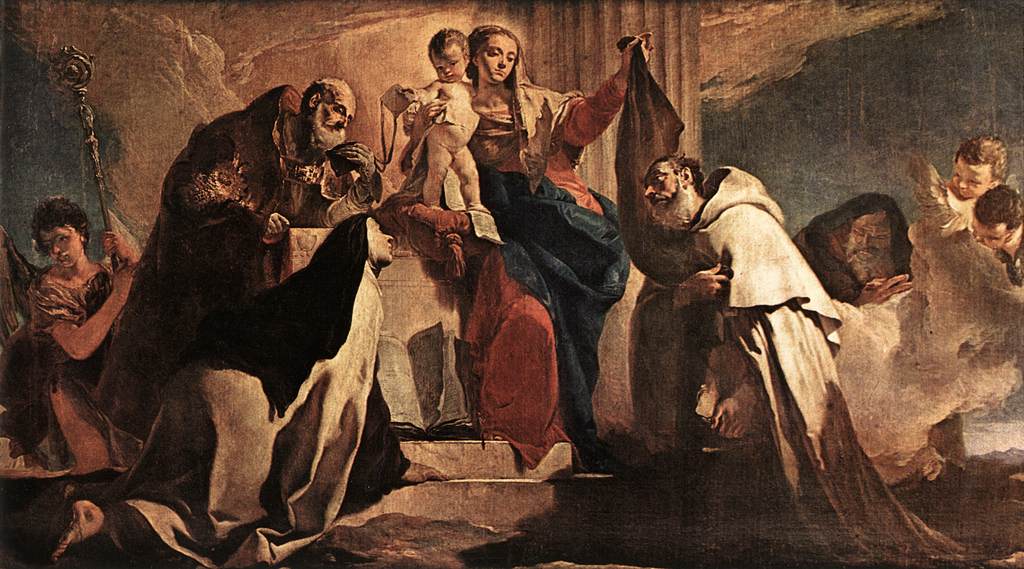
The Madonna of Carmel and the Souls of the Purgatory (detail),
by Giovanni Battista Tiepolo. Oil on canvas, 1730s; Pinacoteca di Brera, Milan.

Wednesday, November 2, 2016

St. Jerome: "Abortion"

YOU MAY see many women widows before wedded, who try to conceal their miserable fall by a lying garb. Unless they are betrayed by swelling wombs or by the crying of their infants, they walk abroad with tripping feet and heads in the air. Some go so far as to take potions, that they may insure barrenness, and thus murder human beings almost before their conception. Some, when they find themselves with child through their sin, use drugs to procure abortion, and when (as often happens) they die with their offspring, they enter the lower world laden with the guilt not only of adultery against Christ but also of suicide and child murder."

~St. Jerome (347-420): Epistula 22.

St. Jerome: Intercession

"IF Apostles and martyrs while still in the body can pray for others, when they ought still to be anxious for themselves, how much more must they do so when once they have won their crowns, overcome, and triumphed? A single man, Moses, oft wins pardon from God for six hundred thousand armed men; and (Acts 7:59-60) Stephen, the follower of his Lord and the first Christian martyr, entreats pardon for his persecutors; and when once they have entered on their life with Christ, shall they have less power than before? The Apostle Paul (Acts 27:37) says that two hundred and seventy-six souls were given to him in the ship; and when, after his dissolution, he has begun to be with Christ, must he shut his mouth, and be unable to say a word for those who throughout the whole world have believed in his Gospel?"

~St. Jerome (c. 340-420): Contra Vigilantium, 6.


St. Augustine: "To reach God is happiness itself"

"FOLLOWING after God is the desire of happiness; to reach God is happiness itself. We follow after God by loving Him; we reach Him, not by becoming entirely what He is, but in nearness to Him, and in wonderful and immaterial contact with Him, and in being inwardly illuminated and occupied by His truth and holiness. He is light itself; we get enlightenment from Him. The greatest commandment, therefore, which leads to happy life, and the first, is this: "You shall love the Lord your God with all your heart, and soul, and mind." For to those who love the Lord all things issue in good. Hence Paul adds shortly after, "I am persuaded that neither death, nor life, nor angels, nor virtue, nor things present, nor things future, nor height, nor depth, nor any other creature, shall be able to separate us from the love of God, which is in Christ Jesus our Lord." (Rom 8:38-39) If, then, to those who love God all things issue in good, and if, as no one doubts, the chief or perfect good is not only to be loved, but to be loved so that nothing shall be loved better, as is expressed in the words, "With all your soul, with all your heart, and with all your mind," who, I ask, will not at once conclude, when these things are all settled and most surely believed, that our chief good which we must hasten to arrive at in preference to all other things is nothing else than God? And then, if nothing can separate us from His love, must not this be surer as well as better than any other good?"

~St. Augustine: De Moribus Ecclesiae Catholicae, Chap. 11.

Thursday, October 6, 2016

St. Augustine: "The last judgment"

"THAT the last judgment, then, shall be administered by Jesus Christ in the manner predicted in the sacred writings is denied or doubted by no one, unless by those who, through some incredible animosity or blindness, decline to believe these writings, though already their truth is demonstrated to all the world. And at or in connection with that judgment the following events shall come to pass, as we have learned: Elias the Tishbite shall come; the Jews shall believe; Antichrist shall persecute; Christ shall judge; the dead shall rise; the good and the wicked shall be separated; the world shall be burned and renewed. All these things, we believe, shall come to pass; but how, or in what order, human understanding cannot perfectly teach us, but only the experience of the events themselves. My opinion, however, is, that they will happen in the order in which I have related them."

~St. Augustine: The City of God, Book XX, Chap. 30.

Last Judgment, by Jan van Eyck. Oil on wood transferred to canvas.
1420-25; Metropolitan Museum of Art, New York.

Sunday, October 2, 2016

St. Ambrose: On guardian angels

“The servants of Christ are protected by invisible, rather than visible, beings. But if these guard you, they do so because they have been summoned by your prayers.”

~St. Ambrose (c. 340 – 397): Sermo contra Auxent., 11.


Linaioli Tabernacle (detail), by Fra Angelico.
Tempera on wood, c. 1433;
Museo di San Marco, Florence.

Saturday, September 3, 2016

On St. Gregory the Great

ST. GREGORY was born at Rome in 540. He was successively senator and prefect of Rome before the age of 30. After five years he resigned and became a monk, transforming his own house into a Benedictine monastery, and founding six others. At the age of 50 he was elected pope, serving from 590 to 604. In 14 years he accomplished much for the Mystical Body of Christ.

After seeing English children being sold as slaves in Rome, he sent 40 monks, including St. Augustine of Canterbury, from his own monastery to make "the Angles angels." England owes her conversion to him. At a period when the invasion of the barbarian Lombards created a new situation in Europe, he played a great part in winning them for Christ. When Rome itself was under attack, he personally went to interview the Lombard King.

At the same time he watched equally over the holiness of the clergy and the maintenance of Church discipline, the temporal interests of his people of Rome and the spiritual interests of all Christendom. He removed unworthy priests from office, forbade taking money for many services, and emptied the papal treasury to ransom prisoners of the Lombards and to care for persecuted Jews and victims of plague and famine. These deeds and others made him, in the words of an antiphon in his office, "the Father of the City, the joy of the World."

Gregory reformed the liturgy, and it still contains several of his most beautiful prayers. The name "Gregorian chant" recalls this great Pope's work in the development of the Church's music. His commentaries on Holy Scripture exercised a considerable influence on Christian thought in the Middle Ages. St. Gregory died on March 12, 604. His body lies at St. Peter's in Rome.

(Source: catholicculture.org)

St. Gregory, by Francesco de Goya y Lucientes.
Oil on canvas, c. 1797; Museo Romántico, Madrid.


Share This