[On the Passion, XI.]
I. The mystery of the Passion passes man's comprehension
The Feast of the Lord's Passion that we have longed for and that the whole world may well desire, has come, and suffers us not to keep silence in the tumult of our spiritual joys: because though it is difficult to speak often on the same thing worthily and appropriately, yet the priest is not free to withhold from the people's ears instruction by sermon on this great mystery of God's mercy, inasmuch as the subject itself, being unspeakable, gives him ease of utterance, and what is said cannot altogether fail where what is said can never be enough. Let human frailty, then, succumb to God's glory, and ever acknowledge itself unequal to the unfolding of His works of mercy. Let us toil in thought, fail in insight, falter in utterance: it is good that even our right thoughts about the Lord's Majesty should be insufficient. For, remembering what the prophet says, “Seek the Lord and be strengthened: seek His face always,” no one must assume that he has found all he seeks, lest he fail of coming near, if he cease his endeavours. And amidst all the works of God which weary out man's wondering contemplation, what so delights and so baffles our mind's gaze as the Saviour's Passion? Ponder as we may upon His omnipotence, which is of one and equal substance with the Father, the humility in God is more stupendous than the power, and it is harder to grasp the complete emptying of the Divine Majesty than the infinite uplifting of the “slave's form” in Him. But we are much aided in our understanding of it by the remembrance that though the Creator and the creature, the Inviolable God and the passible flesh, are absolutely different, yet the properties of both substances meet together in Christ's one Person in such a way that alike in His acts of weakness and of power the degradation belongs to the same Person as the glory.
II. The Creed takes up St. Peter's confession as the fundamental doctrine of the Church
In that rule of Faith, dearly-beloved, which we have received in the very beginning of the Creed, on the authority of apostolic teaching, we acknowledge our Lord Jesus Christ, whom we call the only Son of God the Father Almighty, to be also born of the Virgin Mary by the Holy Ghost. Nor do we reject His Majesty when we express our belief in His crucifixion, death, and resurrection on the third day. For all that is God's and all that is Man's are simultaneously fulfilled by His Manhood and His Godhead, so that in virtue of the union of the Passible with the Impassible, His power cannot be affected by His weakness, nor His weakness overcome by His power. And rightly was the blessed Apostle Peter praised for confessing this union, who when the Lord was inquiring what the disciples knew of Him, quickly anticipated the rest and said, “You are Christ, the Son of the living God.” And this assuredly he saw, not by the revelation of flesh or blood, which might have hindered his inner sight, but by the very Spirit of the Father working in his believing heart, that in preparation for ruling the whole Church he might first learn what he would have to teach, and for the solidification of the Faith, which he was destined to preach, might receive the assurance, “You are Peter, and upon this rock I will build My Church, and the gates of hell shall not prevail against it.” The strength, therefore, of the Christian Faith, which, built upon an impregnable rock, fears not the gates of death, acknowledges the one Lord Jesus Christ to be both true God and true Man, believing Him likewise to be the Virgin's Son, Who is His Mother's Creator: born also at the end of the ages, though He is the Creator of time: Lord of all power, and yet one of mortal stock: ignorant of sin, and yet sacrificed for sinners after the likeness of sinful flesh.
III. The Devil's devices were turned against himself
And in order that He might set the human race free from the bonds of deadly transgression, He hid the power of His majesty from the raging devil, and opposed him with our frail and humble nature. For if the cruel and proud foe could have known the counsel of God's mercy, he would have aimed at soothing the Jews' minds into gentleness rather than at firing them with unrighteous hatred, lest he should lose the thraldom of all his captives in assailing the liberty of One Who owed him nought. Thus he was foiled by his malice: he inflicted a punishment on the Son of God, which was turned to the healing of all the sons of men. He shed righteous Blood, which became the ransom and the drink for the world's atonement. The Lord undertook that which He chose according to the purpose of His own will. He permitted madmen to lay their wicked hands upon Him: hands which, in ministering to their own doom, were of service to the Redeemer's work. And yet so great was His loving compassion for even His murderers, that He prayed to the Father on the cross, and begged not for His own vengeance but for their forgiveness, saying, “Father, forgive them, for they know not what they do (Lk. 23:34).” And such was the power of that prayer, that the hearts of many of those who had said, “His blood be on us and on our sons (Mt. 27:25),” were turned to penitence by the Apostle Peter's preaching, and on one day there were baptized about 3,000 Jews: and they all were “of one heart and of one soul (Acts 4:32),” being ready now to die for Him, Whose crucifixion they had demanded.
IV. Why Judas could not obtain forgiveness through Christ
To this forgiveness the traitor Judas could not attain: for he, the son of perdition, at whose right the devil stood, gave himself up to despair before Christ accomplished the mystery of universal redemption. For in that the Lord died for sinners, perchance even he might have found salvation if he had not hastened to hang himself. But that evil heart, which was now given up to thievish frauds, and now busied with treacherous designs, had never entertained anything of the proofs of the Saviour's mercy. Those wicked ears had heard the Lord's words, when He said, “I came not to call the righteous but sinners (Mt. 9:13),” and “The Son of man came to seek and to save that which was lost (Lk. 19:10),” but they conveyed not to his understanding the clemency of Christ, which not only healed bodily infirmities, but also cured the wounds of sick souls, saying to the paralytic man, “Son, be of good cheer, your sins are forgiven you (Mt. 9:3);” saying also to the adulteress that was brought to Him, “neither will I condemn you; go and sin no more,” to show in all His works that He had come as the Saviour, not the Judge of the world. But the wicked traitor refused to understand this, and took measures against himself, not in the self-condemnation of repentance, but in the madness of perdition, and thus he who had sold the Author of life to His murderers, even in dying increased the amount of sin which condemned him.
V. The cruelty of Christ's crucifixion is lost in its wondrous power
Accordingly that which false witnesses, cruel leaders of the people, wicked priests did against the Lord Jesus Christ, through the agency of a coward governor and an ignorant band of soldiers, has been at once the abhorrence and the rejoicing of all ages. For though the Lord's cross was part of the cruel purpose of the Jews, yet is it of wondrous power through Him they crucified. The people's fury was directed against One, and the mercy of Christ is for all mankind. That which their cruelty inflicts He voluntarily undergoes, in order that the work of His eternal will may be carried out through their unhindered crime. And hence the whole order of events which is most fully narrated in the Gospels must be received by the faithful in such a way that by implicit belief in the occurrences which happened at the time of the Lord's Passion, we should understand that not only was the remission of sins accomplished by Christ, but also the standard of justice satisfied. But that this may be more thoroughly discussed by the Lord's help, let us reserve this portion of the subject till the fourth day of the week. God's grace, we hope, will be vouchsafed at your entreaties to help us to fulfil our promise: through Jesus Christ our Lord, etc. Amen.
+ + +
Source. Nicene and Post-Nicene Fathers, Second Series, Vol. 12. Edited by Philip Schaff and Henry Wace. Buffalo, NY: Christian Literature Publishing Co., 1895.
Saturday, April 4, 2015
St. Augustine: "How have You loved us, O good Father"
"How have You loved us, O good Father, who spared not Your only Son, but delivered Him up for us wicked ones! How have You loved us, for whom He, who thought it no robbery to be equal with You, 'became obedient unto death, even the death of the cross;' (Phil 2:6, 8) He alone 'free among the dead,' that had power to lay down His life, and power to take it again; (Jn. 10:18) for us was He unto You both Victor and Victim, and the Victor as being the Victim; for us was He unto You both Priest and Sacrifice, and Priest as being the Sacrifice; of slaves making us Your sons, by being born of You, and serving us. Rightly, then, is my hope strongly fixed on Him, that You will heal all my diseases by Him who sits at Your right hand and makes intercession for us; (Rom. 8:34) else should I utterly despair. For numerous and great are my infirmities, yea, numerous and great are they; but Your medicine is greater. We might think that Your Word was removed from union with man, and despair of ourselves had He not been 'made flesh and dwelt among us.' (Jn. 1:14)
"Terrified by my sins and the load of my misery, I had resolved in my heart, and meditated flight into the wilderness; but You forbade me, and strengthened me, saying, therefore, 'Christ died for all, that they which live should not henceforth live unto themselves, but unto Him which died for them.' (2 Cor. 5:15) Behold, O Lord, I cast my care upon You, that I may live, and 'behold wondrous things out of Your law.' You know my unskilfulness and my infirmities; teach me, and heal me. Your only Son — 'He in whom are hid all the treasures of wisdom and knowledge' — has redeemed me with His blood. Let not the proud speak evil of me, because I consider my ransom, and eat and drink, and distribute; and poor, desire to be satisfied from Him, together with those who eat and are satisfied, and they praise the Lord that seek him."
~St. Augustine: Confessions, Bk. X, Chap. 43.

"Terrified by my sins and the load of my misery, I had resolved in my heart, and meditated flight into the wilderness; but You forbade me, and strengthened me, saying, therefore, 'Christ died for all, that they which live should not henceforth live unto themselves, but unto Him which died for them.' (2 Cor. 5:15) Behold, O Lord, I cast my care upon You, that I may live, and 'behold wondrous things out of Your law.' You know my unskilfulness and my infirmities; teach me, and heal me. Your only Son — 'He in whom are hid all the treasures of wisdom and knowledge' — has redeemed me with His blood. Let not the proud speak evil of me, because I consider my ransom, and eat and drink, and distribute; and poor, desire to be satisfied from Him, together with those who eat and are satisfied, and they praise the Lord that seek him."
~St. Augustine: Confessions, Bk. X, Chap. 43.
Crucifixion, by Alonso Cano.
Oil on canvas, 1636-38; The Hermitage, St. Petersburg.

Sunday, March 29, 2015
St. Ignatius of Antioch: Epistle to Polycarp
Greeting
Ignatius, who is also called Theophorus, to Polycarp, Bishop of the Church of the Smyrnæans, or rather, who has, as his own bishop, God the Father, and the Lord Jesus Christ: [wishes] abundance of happiness.
Chapter 1. Commendation and exhortation
Having obtained good proof that your mind is fixed in God as upon an immoveable rock, I loudly glorify [His name] that I have been thought worthy [to behold] your blameless face, which may I ever enjoy in God! I entreat you, by the grace with which you are clothed, to press forward in your course, and to exhort all that they may be saved. Maintain your position with all care, both in the flesh and spirit. Have a regard to preserve unity, than which nothing is better. Bear with all, even as the Lord does with you. Support all in love, as also you do. Give yourself to prayer without ceasing. 1 Thessalonians 5:17 Implore additional understanding to what you already have. Be watchful, possessing a sleepless spirit. Speak to every man separately, as God enables you. Bear the infirmities of all, as being a perfect athlete [in the Christian life]: where the labour is great, the gain is all the more.
Chapter 2. Exhortations
If you love the good disciples, no thanks are due to you on that account; but rather seek by meekness to subdue the more troublesome. Every kind of wound is not healed with the same plaster. Mitigate violent attacks [of disease] by gentle applications. Be in all things “wise as a serpent, and harmless as a dove.” (Mt. 10:16 For this purpose you are composed of both flesh and spirit, that you may deal tenderly with those [evils] that present themselves visibly before you. And as respects those that are not seen, pray that [God] would reveal them unto you, in order that you may be wanting in nothing, but may abound in every gift. The times call for you, as pilots do for the winds, and as one tossed with tempest seeks for the haven, so that both you [and those under your care] may attain to God. Be sober as an athlete of God: the prize set before you is immortality and eternal life, of which you are also persuaded. In all things may my soul be for yours, and my bonds also, which you have loved.
Chapter 3. Exhortations
Let not those who seem worthy of credit, but teach strange doctrines, (1 Tim. 1:3, 1 Tim. 6:3) fill you with apprehension. Stand firm, as does an anvil which is beaten. It is the part of a noble athlete to be wounded, and yet to conquer. And especially, we ought to bear all things for the sake of God, that He also may bear with us. Be ever becoming more zealous than what you are. Weigh carefully the times. Look for Him who is above all time, eternal and invisible, yet who became visible for our sakes; impalpable and impassible, yet who became passible on our account; and who in every kind of way suffered for our sakes.
Chapter 4. Exhortations
Let not widows be neglected. Be, after the Lord, their protector and friend. Let nothing be done without your consent; neither do anything without the approval of God, which indeed you do not, inasmuch as you are steadfast. Let your assembling together be of frequent occurrence: seek after all by name. Do not despise either male or female slaves, yet neither let them be puffed up with conceit, but rather let them submit themselves the more, for the glory of God, that they may obtain from God a better liberty. Let them not long to be set free [from slavery] at the public expense, that they be not found slaves to their own desires.
Chapter 5. The duties of husbands and wives
Flee evil arts; but all the more discourse in public regarding them. Speak to my sisters, that they love the Lord, and be satisfied with their husbands both in the flesh and spirit. In like manner also, exhort my brethren, in the name of Jesus Christ, that they love their wives, even as the Lord the Church. (Eph. 5:25) If any one can continue in a state of purity, to the honour of Him who is Lord of the flesh, let him so remain without boasting. If he begins to boast, he is undone; and if he reckon himself greater than the bishop, he is ruined. But it becomes both men and women who marry, to form their union with the approval of the bishop, that their marriage may be according to God, and not after their own lust. Let all things be done to the honour of God. (1 Cor. 10:31)
Chapter 6. The duties of the Christian flock
Give heed to the bishop, that God also may give heed to you. My soul be for theirs that are submissive to the bishop, to the presbyters, and to the deacons, and may my portion be along with them in God! Labour together with one another; strive in company together; run together; suffer together; sleep together; and awake together, as the stewards, and associates, and servants of God. Please Him under whom you fight, and from whom you receive your wages. Let none of you be found a deserter. Let your baptism endure as your arms; your faith as your helmet; your love as your spear; your patience as a complete panoply. Let your works be the charge assigned to you, that you may receive a worthy recompense. Be long-suffering, therefore, with one another, in meekness, as God is towards you. May I have joy of you for ever!
Chapter 7. Request that Polycarp would send a messenger to Antioch
Seeing that the Church which is at Antioch in Syria is, as report has informed me, at peace, through your prayers, I also am the more encouraged, resting without anxiety in God, if indeed by means of suffering I may attain to God, so that, through your prayers, I may be found a disciple [of Christ]. It is fitting, O Polycarp, most blessed in God, to assemble a very solemn council, and to elect one whom you greatly love, and know to be a man of activity, who may be designated the messenger of God; and to bestow on him this honour that he may go into Syria, and glorify your ever active love to the praise of Christ. A Christian has not power over himself, but must always be ready for the service of God. Now, this work is both God's and yours, when you shall have completed it to His glory. For I trust that, through grace, you are prepared for every good work pertaining to God. Knowing, therefore, your energetic love of the truth, I have exhorted you by this brief Epistle.
Chapter 8. Let other churches also send to Antioch
Inasmuch as I have not been able to write to all the Churches, because I must suddenly sail from Troas to Neapolis, as the will [of the emperor] enjoins, [I beg that] you, as being acquainted with the purpose of God, will write to the adjacent Churches, that they also may act in like manner, such as are able to do so sending messengers, and the others transmitting letters through those persons who are sent by you, that you may be glorified by a work which shall be remembered for ever, as indeed you are worthy to be. I salute all by name, and in particular the wife of Epitropus, with all her house and children. I salute Attalus, my beloved. I salute him who shall be deemed worthy to go [from you] into Syria. Grace shall be with him for ever, and with Polycarp that sends him. I pray for your happiness for ever in our God, Jesus Christ, by whom continue in the unity and under the protection of God, I salute Alce, my dearly beloved. Fare well in the Lord.
+ + +
Source: Ante-Nicene Fathers, Vol. 1. Edited by Alexander Roberts, James Donaldson, and A. Cleveland Coxe. Buffalo, NY: Christian Literature Publishing Co., 1885.
● Ignatius of Antioch (AD c. 35 or 50 – 98 to 117.)
Ignatius, who is also called Theophorus, to Polycarp, Bishop of the Church of the Smyrnæans, or rather, who has, as his own bishop, God the Father, and the Lord Jesus Christ: [wishes] abundance of happiness.
Chapter 1. Commendation and exhortation
Having obtained good proof that your mind is fixed in God as upon an immoveable rock, I loudly glorify [His name] that I have been thought worthy [to behold] your blameless face, which may I ever enjoy in God! I entreat you, by the grace with which you are clothed, to press forward in your course, and to exhort all that they may be saved. Maintain your position with all care, both in the flesh and spirit. Have a regard to preserve unity, than which nothing is better. Bear with all, even as the Lord does with you. Support all in love, as also you do. Give yourself to prayer without ceasing. 1 Thessalonians 5:17 Implore additional understanding to what you already have. Be watchful, possessing a sleepless spirit. Speak to every man separately, as God enables you. Bear the infirmities of all, as being a perfect athlete [in the Christian life]: where the labour is great, the gain is all the more.
Chapter 2. Exhortations
If you love the good disciples, no thanks are due to you on that account; but rather seek by meekness to subdue the more troublesome. Every kind of wound is not healed with the same plaster. Mitigate violent attacks [of disease] by gentle applications. Be in all things “wise as a serpent, and harmless as a dove.” (Mt. 10:16 For this purpose you are composed of both flesh and spirit, that you may deal tenderly with those [evils] that present themselves visibly before you. And as respects those that are not seen, pray that [God] would reveal them unto you, in order that you may be wanting in nothing, but may abound in every gift. The times call for you, as pilots do for the winds, and as one tossed with tempest seeks for the haven, so that both you [and those under your care] may attain to God. Be sober as an athlete of God: the prize set before you is immortality and eternal life, of which you are also persuaded. In all things may my soul be for yours, and my bonds also, which you have loved.
Chapter 3. Exhortations
Let not those who seem worthy of credit, but teach strange doctrines, (1 Tim. 1:3, 1 Tim. 6:3) fill you with apprehension. Stand firm, as does an anvil which is beaten. It is the part of a noble athlete to be wounded, and yet to conquer. And especially, we ought to bear all things for the sake of God, that He also may bear with us. Be ever becoming more zealous than what you are. Weigh carefully the times. Look for Him who is above all time, eternal and invisible, yet who became visible for our sakes; impalpable and impassible, yet who became passible on our account; and who in every kind of way suffered for our sakes.
Chapter 4. Exhortations
Let not widows be neglected. Be, after the Lord, their protector and friend. Let nothing be done without your consent; neither do anything without the approval of God, which indeed you do not, inasmuch as you are steadfast. Let your assembling together be of frequent occurrence: seek after all by name. Do not despise either male or female slaves, yet neither let them be puffed up with conceit, but rather let them submit themselves the more, for the glory of God, that they may obtain from God a better liberty. Let them not long to be set free [from slavery] at the public expense, that they be not found slaves to their own desires.
Chapter 5. The duties of husbands and wives
Flee evil arts; but all the more discourse in public regarding them. Speak to my sisters, that they love the Lord, and be satisfied with their husbands both in the flesh and spirit. In like manner also, exhort my brethren, in the name of Jesus Christ, that they love their wives, even as the Lord the Church. (Eph. 5:25) If any one can continue in a state of purity, to the honour of Him who is Lord of the flesh, let him so remain without boasting. If he begins to boast, he is undone; and if he reckon himself greater than the bishop, he is ruined. But it becomes both men and women who marry, to form their union with the approval of the bishop, that their marriage may be according to God, and not after their own lust. Let all things be done to the honour of God. (1 Cor. 10:31)
Chapter 6. The duties of the Christian flock
Give heed to the bishop, that God also may give heed to you. My soul be for theirs that are submissive to the bishop, to the presbyters, and to the deacons, and may my portion be along with them in God! Labour together with one another; strive in company together; run together; suffer together; sleep together; and awake together, as the stewards, and associates, and servants of God. Please Him under whom you fight, and from whom you receive your wages. Let none of you be found a deserter. Let your baptism endure as your arms; your faith as your helmet; your love as your spear; your patience as a complete panoply. Let your works be the charge assigned to you, that you may receive a worthy recompense. Be long-suffering, therefore, with one another, in meekness, as God is towards you. May I have joy of you for ever!
Chapter 7. Request that Polycarp would send a messenger to Antioch
Seeing that the Church which is at Antioch in Syria is, as report has informed me, at peace, through your prayers, I also am the more encouraged, resting without anxiety in God, if indeed by means of suffering I may attain to God, so that, through your prayers, I may be found a disciple [of Christ]. It is fitting, O Polycarp, most blessed in God, to assemble a very solemn council, and to elect one whom you greatly love, and know to be a man of activity, who may be designated the messenger of God; and to bestow on him this honour that he may go into Syria, and glorify your ever active love to the praise of Christ. A Christian has not power over himself, but must always be ready for the service of God. Now, this work is both God's and yours, when you shall have completed it to His glory. For I trust that, through grace, you are prepared for every good work pertaining to God. Knowing, therefore, your energetic love of the truth, I have exhorted you by this brief Epistle.
Chapter 8. Let other churches also send to Antioch
Inasmuch as I have not been able to write to all the Churches, because I must suddenly sail from Troas to Neapolis, as the will [of the emperor] enjoins, [I beg that] you, as being acquainted with the purpose of God, will write to the adjacent Churches, that they also may act in like manner, such as are able to do so sending messengers, and the others transmitting letters through those persons who are sent by you, that you may be glorified by a work which shall be remembered for ever, as indeed you are worthy to be. I salute all by name, and in particular the wife of Epitropus, with all her house and children. I salute Attalus, my beloved. I salute him who shall be deemed worthy to go [from you] into Syria. Grace shall be with him for ever, and with Polycarp that sends him. I pray for your happiness for ever in our God, Jesus Christ, by whom continue in the unity and under the protection of God, I salute Alce, my dearly beloved. Fare well in the Lord.
+ + +
Source: Ante-Nicene Fathers, Vol. 1. Edited by Alexander Roberts, James Donaldson, and A. Cleveland Coxe. Buffalo, NY: Christian Literature Publishing Co., 1885.
● Ignatius of Antioch (AD c. 35 or 50 – 98 to 117.)
Friday, March 27, 2015
St. John Damascene: "This blessed woman"
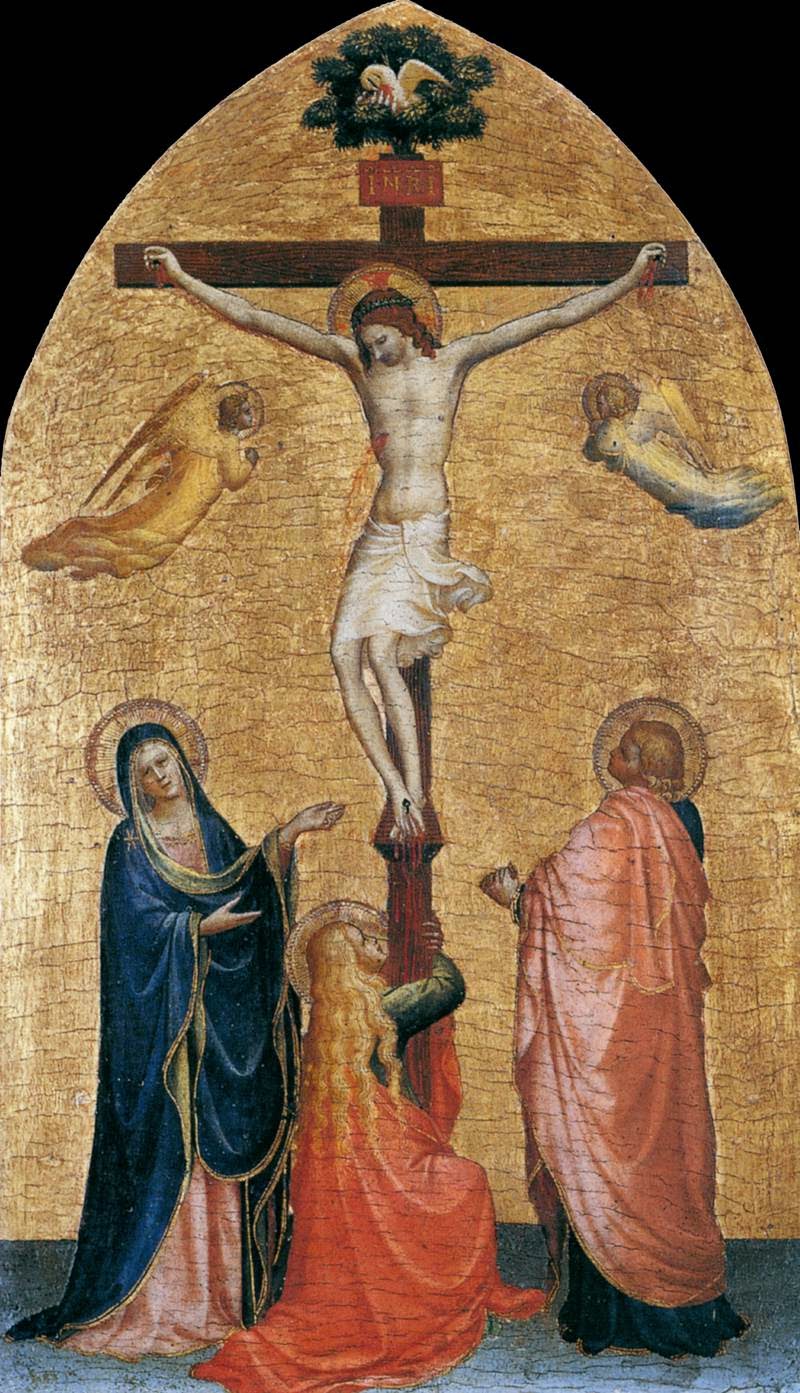
"But this blessed woman, who was deemed worthy of gifts that are supernatural, suffered those pains, which she escaped at the birth, in the hour of the passion, enduring from motherly sympathy the rending of the bowels, and when she beheld Him, Whom she knew to be God by the manner of His generation, killed as a malefactor, her thoughts pierced her as a sword, and this is the meaning of this verse: "Yea, a sword shall pierce through your own soul also" (Lk. 2:35)."
~St. John Damascene: An Exposition of the Orthodox Faith, Bk. IV, Chap. 14.
~St. John Damascene: An Exposition of the Orthodox Faith, Bk. IV, Chap. 14.
Crucifixion with the Virgin, John the Evangelist, and Mary Magdelene.
By Fra Angelico. Tempera and gold on panel, 1419-20; Private collection.
By Fra Angelico. Tempera and gold on panel, 1419-20; Private collection.
St. John Damascene: the Annunciation
Lent: March 25th — Solemnity of the Annunciation of the Lord.
"SO then, after the assent of the holy Virgin, the Holy Spirit descended on her, according to the word of the Lord which the angel spoke, purifying her, and granting her power to receive the divinity of the Word, and likewise power to bring forth."
~St. John Damascene: An Exposition of the Orthodox Faith, Bk. III, Ch. 2.

"SO then, after the assent of the holy Virgin, the Holy Spirit descended on her, according to the word of the Lord which the angel spoke, purifying her, and granting her power to receive the divinity of the Word, and likewise power to bring forth."
~St. John Damascene: An Exposition of the Orthodox Faith, Bk. III, Ch. 2.
The Annunciation, by Fra Angelico.
Tempera on wood, 1430-32; Museo del Prado, Madrid.
Byzantine: the Annunciation
“TODAY is the crowning of our salvation, and the manifestation of the mystery which was from eternity. The Son of God becometh the Son of the Virgin, and Gabriel giveth the good tidings of grace. Therefore with him let us cry to the Mother of God, Hail! Full of grace, the Lord is with thee.”
~Byzantine Menaea, Troparion for the Feast (Mar. 25). (ca. 6th cent.)

~Byzantine Menaea, Troparion for the Feast (Mar. 25). (ca. 6th cent.)
(Image from the Byzantine Gallery)
Tuesday, March 24, 2015
St. Leo the Great: Sermon on the Passion (III)
Sermon 54
(On the Passion, III.; delivered on the Sunday before Easter.)
I. The two-fold nature of Christ set forth
Among all the works of God's mercy, dearly-beloved, which from the beginning have been bestowed upon men's salvation, none is more wondrous, and none more sublime, than that Christ was crucified for the world. For to this mystery all the mysteries of the ages preceding led up, and every variation which the will of God ordained in sacrifices, in prophetic signs, and in the observances of the Law, foretold that this was fixed, and promised its fulfilment: so that now types and figures are at an end, and we find our profit in believing that accomplished which before we found our profit in looking forward to. In all things, therefore, dearly-beloved, which pertain to the Passion of our Lord Jesus Christ, the Catholic Faith maintains and demands that we acknowledge the two Natures to have met in our Redeemer, and while their properties remained, such a union of both Natures to have been effected that, from the time when, as the cause of mankind required, in the blessed Virgin's womb, “the Word became flesh,” we may not think of Him as God without that which is man, nor as man without that which is God. Each Nature does indeed express its real existence by actions that distinguish it, but neither separates itself from connection with the other. Nothing is wanting there on either side; in the majesty the humility is complete, in the humility the majesty is complete: and the unity does not introduce confusion, nor does the distinctiveness destroy the unity. The one is passible, the other inviolable; and yet the degradation belongs to the same Person, as does the glory. He is present at once in weakness and in power; at once capable of death and the vanquisher of it. Therefore, God took on Him whole Manhood, and so blended the two Natures together by means of His mercy and power, that each Nature was present in the other, and neither passed out of its own properties into the other.
II. The two natures acted conjointly, and the human sufferings were not compulsory, but in accordance with the Divine will
But because the design of that mystery which was ordained for our restoration before the eternal ages, was not to be carried out without human weakness and without Divine power, both “form” does that which is proper to it in common with the other, the Word, that is, performing that which is the Word's and the flesh that which is of the flesh. One of them gleams bright with miracles, the other succumbs to injuries. The one departs not from equality with the Father's glory, the other leaves not the nature of our race. But nevertheless even His very endurance of sufferings does not so far expose Him to a participation in our humility as to separate Him from the power of the Godhead. All the mockery and insults, all the persecution and pain which the madness of the wicked inflicted on the Lord, was not endured of necessity, but undertaken of free-will: “for the Son of Man came to seek and to save that which had perished (Lk 19:10):” and He used the wickedness of His persecutors for the redemption of all men in such a way that in the mystery of His Death and Resurrection even His murderers could have been saved, if they had believed.
III. Judas' infamy has never been exceeded
And hence, Judas, you are proved more criminal and unhappier than all; for when repentance should have called you back to the Lord, despair dragged you to the halter. You should have awaited the completion of your crime, and have put off your ghastly death by hanging, until Christ's Blood was shed for all sinners. And among the many miracles and gifts of the Lord's which might have aroused your conscience, those holy mysteries, at least, might have rescued you from your headlong fall, which at the Paschal supper you had received, being even then detected in your treachery by the sign of Divine knowledge. Why do you distrust the goodness of Him, Who did not repel you from the communion of His body and blood, Who did not deny you the kiss of peace when you came with crowds and a band of armed men to seize Him. But O man that nothing could convert, O “spirit going and not returning,” you followed your heart's rage, and, the devil standing at your right hand, turned the wickedness, which you had prepared against the life of all the saints, to your own destruction, so that, because your crime had exceeded all measure of punishment, your wickedness might make you your own judge, your punishment allow you to be your own hangman.
IV. Christ voluntarily bartered His glory for our weakness
When, therefore, “God was in Christ reconciling the world to Himself (2 Cor. 5:19),” and the Creator Himself was wearing the creature which was to be restored to the image of its Creator; and after the Divinely-miraculous works had been performed, the performance of which the spirit of prophecy had once predicted, “then shall the eyes of the blind be opened and the ears of the deaf shall hear; then shall the lame man leap as a hart, and the tongue of the dumb shall be plain (Is. 35:5-6);” Jesus knowing that the time was now come for the fulfilment of His glorious Passion, said, “My soul is sorrowful even unto death (Mt 26:38-39);” and again, “Father, if it be possible, let this cup pass from Me (Mt. 26:38-39).” And these words, expressing a certain fear, show His desire to heal the affection of our weakness by sharing them, and to check our fear of enduring pain by undergoing it. In our Nature, therefore, the Lord trembled with our fear, that He might fully clothe our weakness and our frailty with the completeness of His own strength. For He had come into this world a rich and merciful Merchant from the skies, and by a wondrous exchange had entered into a bargain of salvation with us, receiving ours and giving His, honour for insults, salvation for pain, life for death: and He Whom more than 12,000 of the angel-hosts might have served for the annihilation of His persecutors, preferred to entertain our fears, rather than employ His own power.
V. St. Peter was the first to benefit by his Master's humiliation
And how much this humiliation conferred upon all the faithful, the most blessed Apostle Peter was the first to prove, who, after the fierce blast of threatening cruelty had dismayed him, quickly changed, and was restored to vigour, finding remedy from the great Pattern, so that the suddenly-shaken member returned to the firmness of the Head. For the bond-servant could not be “greater than the Lord, nor the disciple greater than the master,” and he could not have vanquished the trembling of human frailty had not the Vanquisher of Death first feared. The Lord, therefore, “looked back upon Peter,” and amid the calumnies of priests, the falsehoods of witnesses, the injuries of those that scourged and spat upon Him, met His dismayed disciple with those eyes wherewith He had foreseen his dismay: and the gaze of the Truth entered into him, on whose heart correction must be wrought, as if the Lord's voice were making itself heard there, and saying, Where are you going, Peter? Why do you retire upon yourself? Turn to Me, put your trust in Me, follow Me: this is the time of My Passion, the hour of your suffering is not yet come. Why do you fear what you, too, shall overcome? Let not the weakness, in which I share, confound you. I was fearful for you; be confident of Me.
VI. The mad counsel of the Jews was turned to their own destruction
“And when morning had come all the chief priests and elders of the people took counsel against Jesus to put him to death (Mt. 27:1).” This morning, O you Jews, was for you not the rising, but the setting of the sun, nor did the wonted daylight visit your eyes, but a night of blackest darkness brooded on your naughty hearts. This morning overthrew for you the temple and its altars, did away with the Law and the Prophets, destroyed the Kingdom and the priesthood, turned all your feasts into eternal mourning. For you resolved on a mad and bloody counsel, you “fat bulls,” you “many oxen,” you “roaring” wild beasts, you rabid “dogs,” to give up to death the Author of life and the Lord of glory; and, as if the enormity of your fury could be palliated by employing the verdict of him, who ruled your province, you lead Jesus bound to Pilate's judgment, that the terror-stricken judge being overcome by your persistent shouts, you might choose a man that was a murderer for pardon, and demand the crucifixion of the Saviour of the world. After this condemnation of Christ, brought about more by the cowardice than the power of Pilate, who with washed hands but polluted mouth sent Jesus to the cross with the very lips that had pronounced Him innocent, the licence of the people, obedient to the looks of the priests, heaped many insults on the Lord, and the frenzied mob wreaked its rage on Him, Who meekly and voluntarily endured it all. But because, dearly-beloved, the whole story is too long to go through today, let us put off the rest till Wednesday, when the reading of the Lord's Passion will be repeated. For the Lord will grant to your prayers, that of His own free gift we may fulfil our promise: through our Lord Jesus Christ, Who lives and reigns for ever and ever. Amen.
+ + +
Source: Nicene and Post-Nicene Fathers, Second Series, Vol. 12. Edited by Philip Schaff and Henry Wace. Buffalo, NY: Christian Literature Publishing Co., 1895.

(On the Passion, III.; delivered on the Sunday before Easter.)
I. The two-fold nature of Christ set forth
Among all the works of God's mercy, dearly-beloved, which from the beginning have been bestowed upon men's salvation, none is more wondrous, and none more sublime, than that Christ was crucified for the world. For to this mystery all the mysteries of the ages preceding led up, and every variation which the will of God ordained in sacrifices, in prophetic signs, and in the observances of the Law, foretold that this was fixed, and promised its fulfilment: so that now types and figures are at an end, and we find our profit in believing that accomplished which before we found our profit in looking forward to. In all things, therefore, dearly-beloved, which pertain to the Passion of our Lord Jesus Christ, the Catholic Faith maintains and demands that we acknowledge the two Natures to have met in our Redeemer, and while their properties remained, such a union of both Natures to have been effected that, from the time when, as the cause of mankind required, in the blessed Virgin's womb, “the Word became flesh,” we may not think of Him as God without that which is man, nor as man without that which is God. Each Nature does indeed express its real existence by actions that distinguish it, but neither separates itself from connection with the other. Nothing is wanting there on either side; in the majesty the humility is complete, in the humility the majesty is complete: and the unity does not introduce confusion, nor does the distinctiveness destroy the unity. The one is passible, the other inviolable; and yet the degradation belongs to the same Person, as does the glory. He is present at once in weakness and in power; at once capable of death and the vanquisher of it. Therefore, God took on Him whole Manhood, and so blended the two Natures together by means of His mercy and power, that each Nature was present in the other, and neither passed out of its own properties into the other.
II. The two natures acted conjointly, and the human sufferings were not compulsory, but in accordance with the Divine will
But because the design of that mystery which was ordained for our restoration before the eternal ages, was not to be carried out without human weakness and without Divine power, both “form” does that which is proper to it in common with the other, the Word, that is, performing that which is the Word's and the flesh that which is of the flesh. One of them gleams bright with miracles, the other succumbs to injuries. The one departs not from equality with the Father's glory, the other leaves not the nature of our race. But nevertheless even His very endurance of sufferings does not so far expose Him to a participation in our humility as to separate Him from the power of the Godhead. All the mockery and insults, all the persecution and pain which the madness of the wicked inflicted on the Lord, was not endured of necessity, but undertaken of free-will: “for the Son of Man came to seek and to save that which had perished (Lk 19:10):” and He used the wickedness of His persecutors for the redemption of all men in such a way that in the mystery of His Death and Resurrection even His murderers could have been saved, if they had believed.
III. Judas' infamy has never been exceeded
And hence, Judas, you are proved more criminal and unhappier than all; for when repentance should have called you back to the Lord, despair dragged you to the halter. You should have awaited the completion of your crime, and have put off your ghastly death by hanging, until Christ's Blood was shed for all sinners. And among the many miracles and gifts of the Lord's which might have aroused your conscience, those holy mysteries, at least, might have rescued you from your headlong fall, which at the Paschal supper you had received, being even then detected in your treachery by the sign of Divine knowledge. Why do you distrust the goodness of Him, Who did not repel you from the communion of His body and blood, Who did not deny you the kiss of peace when you came with crowds and a band of armed men to seize Him. But O man that nothing could convert, O “spirit going and not returning,” you followed your heart's rage, and, the devil standing at your right hand, turned the wickedness, which you had prepared against the life of all the saints, to your own destruction, so that, because your crime had exceeded all measure of punishment, your wickedness might make you your own judge, your punishment allow you to be your own hangman.
IV. Christ voluntarily bartered His glory for our weakness
When, therefore, “God was in Christ reconciling the world to Himself (2 Cor. 5:19),” and the Creator Himself was wearing the creature which was to be restored to the image of its Creator; and after the Divinely-miraculous works had been performed, the performance of which the spirit of prophecy had once predicted, “then shall the eyes of the blind be opened and the ears of the deaf shall hear; then shall the lame man leap as a hart, and the tongue of the dumb shall be plain (Is. 35:5-6);” Jesus knowing that the time was now come for the fulfilment of His glorious Passion, said, “My soul is sorrowful even unto death (Mt 26:38-39);” and again, “Father, if it be possible, let this cup pass from Me (Mt. 26:38-39).” And these words, expressing a certain fear, show His desire to heal the affection of our weakness by sharing them, and to check our fear of enduring pain by undergoing it. In our Nature, therefore, the Lord trembled with our fear, that He might fully clothe our weakness and our frailty with the completeness of His own strength. For He had come into this world a rich and merciful Merchant from the skies, and by a wondrous exchange had entered into a bargain of salvation with us, receiving ours and giving His, honour for insults, salvation for pain, life for death: and He Whom more than 12,000 of the angel-hosts might have served for the annihilation of His persecutors, preferred to entertain our fears, rather than employ His own power.
V. St. Peter was the first to benefit by his Master's humiliation
And how much this humiliation conferred upon all the faithful, the most blessed Apostle Peter was the first to prove, who, after the fierce blast of threatening cruelty had dismayed him, quickly changed, and was restored to vigour, finding remedy from the great Pattern, so that the suddenly-shaken member returned to the firmness of the Head. For the bond-servant could not be “greater than the Lord, nor the disciple greater than the master,” and he could not have vanquished the trembling of human frailty had not the Vanquisher of Death first feared. The Lord, therefore, “looked back upon Peter,” and amid the calumnies of priests, the falsehoods of witnesses, the injuries of those that scourged and spat upon Him, met His dismayed disciple with those eyes wherewith He had foreseen his dismay: and the gaze of the Truth entered into him, on whose heart correction must be wrought, as if the Lord's voice were making itself heard there, and saying, Where are you going, Peter? Why do you retire upon yourself? Turn to Me, put your trust in Me, follow Me: this is the time of My Passion, the hour of your suffering is not yet come. Why do you fear what you, too, shall overcome? Let not the weakness, in which I share, confound you. I was fearful for you; be confident of Me.
VI. The mad counsel of the Jews was turned to their own destruction
“And when morning had come all the chief priests and elders of the people took counsel against Jesus to put him to death (Mt. 27:1).” This morning, O you Jews, was for you not the rising, but the setting of the sun, nor did the wonted daylight visit your eyes, but a night of blackest darkness brooded on your naughty hearts. This morning overthrew for you the temple and its altars, did away with the Law and the Prophets, destroyed the Kingdom and the priesthood, turned all your feasts into eternal mourning. For you resolved on a mad and bloody counsel, you “fat bulls,” you “many oxen,” you “roaring” wild beasts, you rabid “dogs,” to give up to death the Author of life and the Lord of glory; and, as if the enormity of your fury could be palliated by employing the verdict of him, who ruled your province, you lead Jesus bound to Pilate's judgment, that the terror-stricken judge being overcome by your persistent shouts, you might choose a man that was a murderer for pardon, and demand the crucifixion of the Saviour of the world. After this condemnation of Christ, brought about more by the cowardice than the power of Pilate, who with washed hands but polluted mouth sent Jesus to the cross with the very lips that had pronounced Him innocent, the licence of the people, obedient to the looks of the priests, heaped many insults on the Lord, and the frenzied mob wreaked its rage on Him, Who meekly and voluntarily endured it all. But because, dearly-beloved, the whole story is too long to go through today, let us put off the rest till Wednesday, when the reading of the Lord's Passion will be repeated. For the Lord will grant to your prayers, that of His own free gift we may fulfil our promise: through our Lord Jesus Christ, Who lives and reigns for ever and ever. Amen.
+ + +
Source: Nicene and Post-Nicene Fathers, Second Series, Vol. 12. Edited by Philip Schaff and Henry Wace. Buffalo, NY: Christian Literature Publishing Co., 1895.
Taking of Christ, by Caravaggio.
Oil on canvas, c. 1602; National Gallery of Ireland, Dublin.
Subscribe to:
Posts (Atom)
Share This
